Building a Championship Kickoff Unit: Inside Monmouth’s Teaching Progression
August 25, 2026
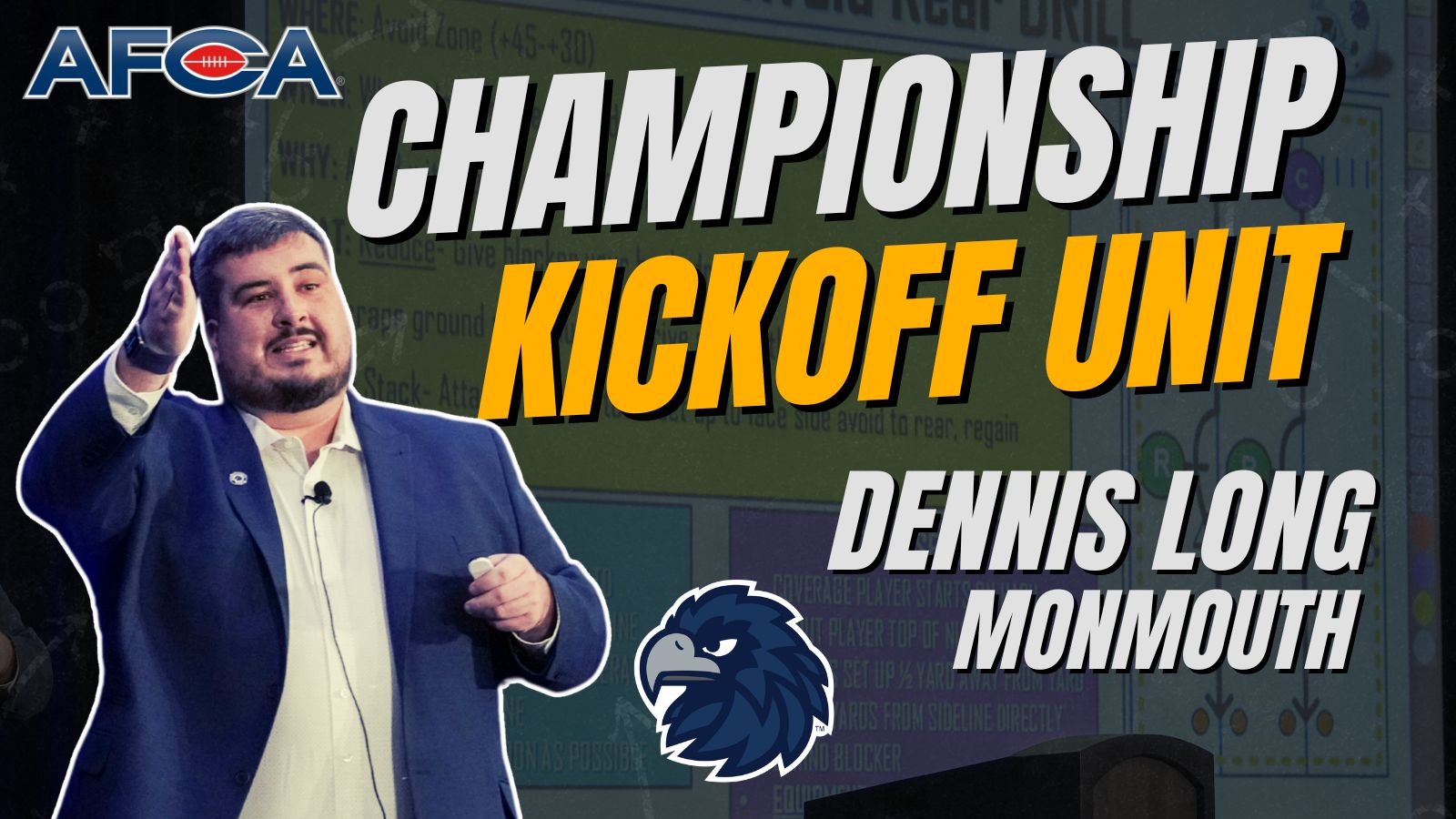
At the 2026 AFCA Convention, Monmouth University special teams coordinator Coach Dennis Long broke down the drill work, teaching progressions, and in-season philosophy that have made the Hawks’ kickoff coverage unit one of the most reliable units on the field. Coach Long built his presentation around a simple idea: with limited practice time, every rep has to count.
A Four-Step Teaching Progression
Monmouth’s teaching progression for installing drill work follows four steps. The process starts in the meeting room, where players see the drill diagrammed on paper, complete with coaching points and still images of proper technique. From there, players watch the drill on film to see exactly what good execution looks like before ever stepping on the field. The third step ties the drill directly to a game rep, since most players on a kickoff unit were not recruited to play special teams and need to see why the work matters. Only after those three steps does the unit attack the drill at full speed, maximizing the limited number of reps available in a typical practice window.
The throughline for every drill comes back to two core values for the kickoff unit: speed and violence.
Circuit Work: Avoid and Contact
To keep practice efficient and players engaged, Monmouth organizes its spring and fall camp work into two circuits: an avoid circuit and a contact circuit. Coach Long notes that running one or two drills for long stretches invites boredom and sloppy habits, so the staff constantly rotates players through stations to maintain energy and focus.
Avoid Circuit
The avoid circuit features three drills:
- Avoid Face – used when a blocker does not obstruct the coverage player’s line of vision to the returner. The player works to the blocker’s face side, emphasizing a reduced surface area, an exaggerated rip through the sky, and a bend back toward the returner.
- Avoid Rear – used when the blocker is within the coverage player’s line of vision. Instead of dropping all the way to the ground on the rip, the player stems and stacks, clearing the blocker’s hands and regaining vertical leverage more quickly.
- Cross Face – used when a player is off his angle and needs to work back into his lane, chopping through the blocker’s hands to avoid ever running past the level of the returner.
Coach Long stresses keeping equipment simple, just cones, towels, and arm sleeves, so the drills can be run by any staff with limited resources. Position coaches are assigned to specific stations and asked to master one drill rather than spread themselves across the entire circuit.
Contact Circuit
The contact circuit covers situations where avoidance is not an option:
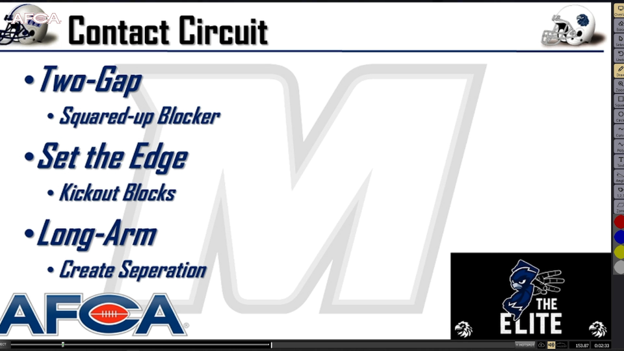
- Two Gap – press, drive, and escape technique for when a blocker is squared up on the coverage player. Coaching points include thumbs up, tight elbows, gaining ground through contact, and tearing the block away once the returner declares.
- Box and Spill – used by edge setters against kickout blocks. On the box technique, players strike low to high and squeeze the blocker back toward the ball. On the spill technique, players attack the inside shoulder and work up the field, forcing the ball toward the boundary.
- Long Arm – used when a blocker is in phase or working an angle. Players stab and extend the near arm, keep their feet driving, and either rip through or pull through depending on who wins leverage.
Coach Long points out that the long arm technique is not exclusive to kickoff and showed film of a Monmouth gunner using the same move in punt coverage.
Competing and Tracking Results
Before introducing competitive drill work, Long shows his players a simple message about effort and buy-in, separating the players who love football from those who are simply going through the motions. To reinforce that standard, Monmouth tracks every competitive rep during camp, recording wins, losses, and total reps taken. That data becomes part of depth chart conversations later in the season and gives coaches a concrete answer when a player questions his playing time.
The one-on-one and three-on-three drills simulate live kickoff situations in a compressed space, combining the avoid and contact circuits with a returner trying to catch and create a lane. Long said these reps are valuable because live kickoff opportunities are rare in camp, and the competitive setting reveals which players are actually applying what they have been taught before the games start to count.
In-Season Maintenance
Rather than dedicating one long practice period to kickoff each week, Monmouth spreads the work across multiple days, typically five minutes on Tuesday and five minutes on Wednesday, with situational work added later in the week. Game-specific kickoff schemes are installed on Sundays once the coaching staff has finalized the plan for that week’s opponent.
Tuesday practices focus on individual technique by position group rather than circuit rotation, covering specific fits such as:
- Box and fold fitters for the 1, 2, 9, and 10 positions, focused on compressing and containing the football
- Lever, spill, and lever fitters, who adjust on the fly if a teammate gets doubled and must shift into a different leverage assignment
- Post, stack, and trigger fitters for the 7 and 8 positions, who divide responsibility for keeping outside leverage and triggering downhill once the return direction is clear
Reading the Return
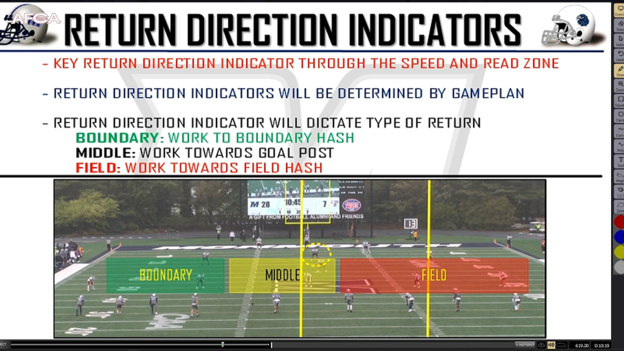
A key addition to Monmouth’s approach this season was tying individual fits to a return direction indicator identified in the weekly game plan, typically based on the speed of release on the front line. Long showed examples from Fordham, Colgate, and Bryant where Monmouth correctly diagnosed a boundary or field return before the snap and walked players through exactly how each position should fit the play. Because the fits were rehearsed against actual opponent tendencies, players were able to execute the same fits in live game action with minimal hesitation.
JOIN THE AFCA
Take your coaching development beyond the clinic by joining the American Football Coaches Association. AFCA Membership is open and connects you with coaching education, professional development, resources, and a network of coaches from across the profession.
Make plans to join us in Indianapolis for the 2027 AFCA Convention, February 14–16, and experience three days of education, networking, and opportunities to connect with coaches at every level of the game.
Visit https://www.afca.com/become-a-member/ to become an AFCA member and learn more about the 2027 AFCA Convention.

For more information about the AFCA, visit www.AFCA.com. For more interesting articles, check out The Insider and subscribe to our weekly email.
If you are interested in more in-depth articles and videos, please become an AFCA member. You can find out more information about membership and specific member benefits on the AFCA Membership Overview page. If you are ready to join, please fill out the AFCA Membership Application.
« « Previous PostNext Post » »
At the 2026 AFCA Convention, Monmouth University special teams coordinator Coach Dennis Long broke down the drill work, teaching progressions, and in-season philosophy that have made the Hawks’ kickoff coverage unit one of the most reliable units on the field. Coach Long built his presentation around a simple idea: with limited practice time, every rep has to count.
A Four-Step Teaching Progression
Monmouth’s teaching progression for installing drill work follows four steps. The process starts in the meeting room, where players see the drill diagrammed on paper, complete with coaching points and still images of proper technique. From there, players watch the drill on film to see exactly what good execution looks like before ever stepping on the field. The third step ties the drill directly to a game rep, since most players on a kickoff unit were not recruited to play special teams and need to see why the work matters. Only after those three steps does the unit attack the drill at full speed, maximizing the limited number of reps available in a typical practice window.
The throughline for every drill comes back to two core values for the kickoff unit: speed and violence.
Circuit Work: Avoid and Contact
To keep practice efficient and players engaged, Monmouth organizes its spring and fall camp work into two circuits: an avoid circuit and a contact circuit. Coach Long notes that running one or two drills for long stretches invites boredom and sloppy habits, so the staff constantly rotates players through stations to maintain energy and focus.
Avoid Circuit
The avoid circuit features three drills:
- Avoid Face – used when a blocker does not obstruct the coverage player’s line of vision to the returner. The player works to the blocker’s face side, emphasizing a reduced surface area, an exaggerated rip through the sky, and a bend back toward the returner.
- Avoid Rear – used when the blocker is within the coverage player’s line of vision. Instead of dropping all the way to the ground on the rip, the player stems and stacks, clearing the blocker’s hands and regaining vertical leverage more quickly.
- Cross Face – used when a player is off his angle and needs to work back into his lane, chopping through the blocker’s hands to avoid ever running past the level of the returner.
Coach Long stresses keeping equipment simple, just cones, towels, and arm sleeves, so the drills can be run by any staff with limited resources. Position coaches are assigned to specific stations and asked to master one drill rather than spread themselves across the entire circuit.
Contact Circuit
The contact circuit covers situations where avoidance is not an option:
- Two Gap – press, drive, and escape technique for when a blocker is squared up on the coverage player. Coaching points include thumbs up, tight elbows, gaining ground through contact, and tearing the block away once the returner declares.
- Box and Spill – used by edge setters against kickout blocks. On the box technique, players strike low to high and squeeze the blocker back toward the ball. On the spill technique, players attack the inside shoulder and work up the field, forcing the ball toward the boundary.
- Long Arm – used when a blocker is in phase or working an angle. Players stab and extend the near arm, keep their feet driving, and either rip through or pull through depending on who wins leverage.
Coach Long points out that the long arm technique is not exclusive to kickoff and showed film of a Monmouth gunner using the same move in punt coverage.
Competing and Tracking Results
Before introducing competitive drill work, Long shows his players a simple message about effort and buy-in, separating the players who love football from those who are simply going through the motions. To reinforce that standard, Monmouth tracks every competitive rep during camp, recording wins, losses, and total reps taken. That data becomes part of depth chart conversations later in the season and gives coaches a concrete answer when a player questions his playing time.
The one-on-one and three-on-three drills simulate live kickoff situations in a compressed space, combining the avoid and contact circuits with a returner trying to catch and create a lane. Long said these reps are valuable because live kickoff opportunities are rare in camp, and the competitive setting reveals which players are actually applying what they have been taught before the games start to count.
In-Season Maintenance
Rather than dedicating one long practice period to kickoff each week, Monmouth spreads the work across multiple days, typically five minutes on Tuesday and five minutes on Wednesday, with situational work added later in the week. Game-specific kickoff schemes are installed on Sundays once the coaching staff has finalized the plan for that week’s opponent.
Tuesday practices focus on individual technique by position group rather than circuit rotation, covering specific fits such as:
- Box and fold fitters for the 1, 2, 9, and 10 positions, focused on compressing and containing the football
- Lever, spill, and lever fitters, who adjust on the fly if a teammate gets doubled and must shift into a different leverage assignment
- Post, stack, and trigger fitters for the 7 and 8 positions, who divide responsibility for keeping outside leverage and triggering downhill once the return direction is clear
Reading the Return
A key addition to Monmouth’s approach this season was tying individual fits to a return direction indicator identified in the weekly game plan, typically based on the speed of release on the front line. Long showed examples from Fordham, Colgate, and Bryant where Monmouth correctly diagnosed a boundary or field return before the snap and walked players through exactly how each position should fit the play. Because the fits were rehearsed against actual opponent tendencies, players were able to execute the same fits in live game action with minimal hesitation.
JOIN THE AFCA
Take your coaching development beyond the clinic by joining the American Football Coaches Association. AFCA Membership is open and connects you with coaching education, professional development, resources, and a network of coaches from across the profession.
Make plans to join us in Indianapolis for the 2027 AFCA Convention, February 14–16, and experience three days of education, networking, and opportunities to connect with coaches at every level of the game.
Visit https://www.afca.com/become-a-member/ to become an AFCA member and learn more about the 2027 AFCA Convention.
For more information about the AFCA, visit www.AFCA.com. For more interesting articles, check out The Insider and subscribe to our weekly email.
If you are interested in more in-depth articles and videos, please become an AFCA member. You can find out more information about membership and specific member benefits on the AFCA Membership Overview page. If you are ready to join, please fill out the AFCA Membership Application.