Building an In-Season Defensive Game Plan from Saturday to Thursday
July 8, 2026
Building an In-Season Defensive Game Plan from Saturday to Thursday
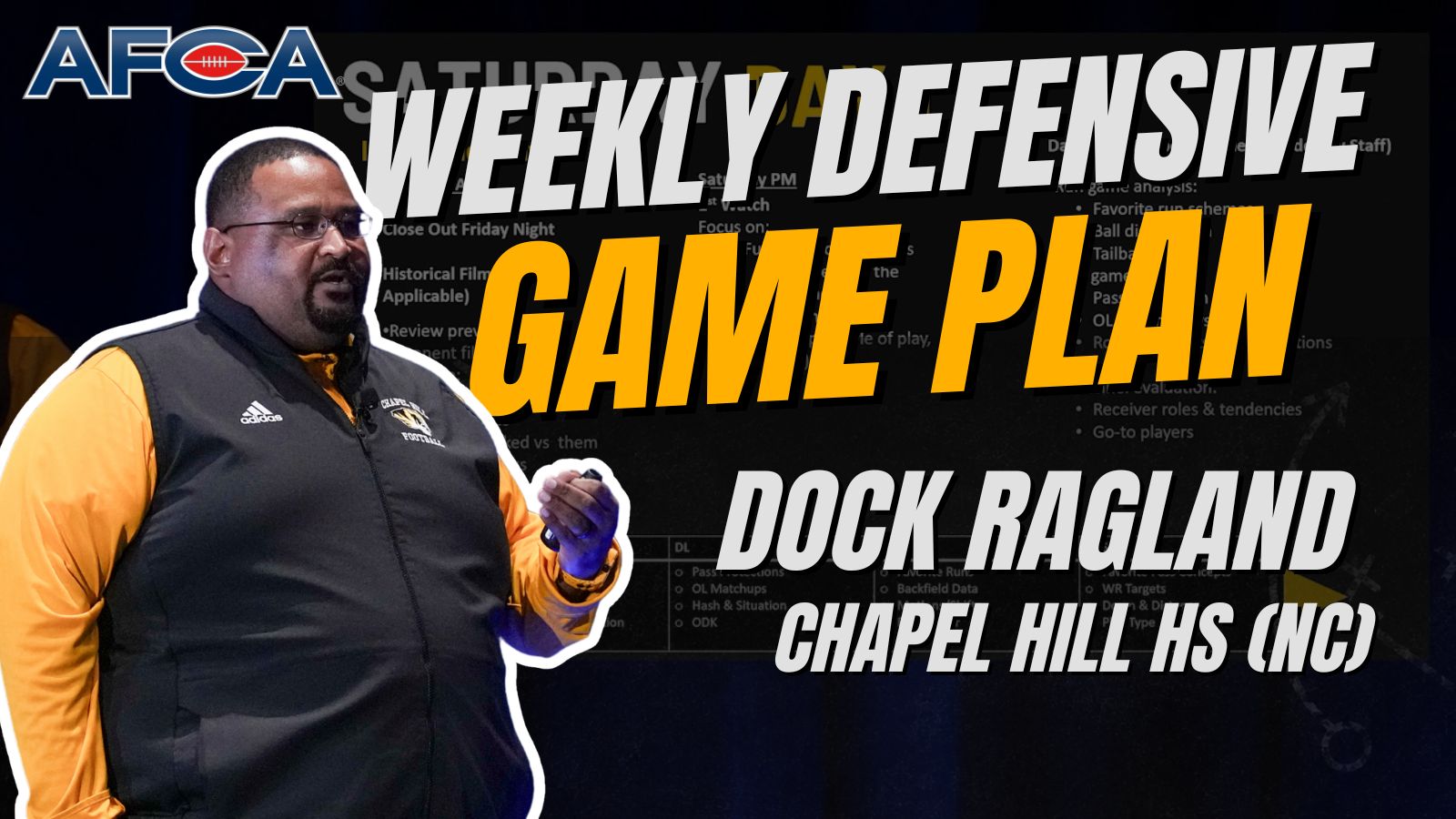
At the 2026 AFCA Convention, Chapel Hill (N.C.) High School Defensive Coordinator Dock Ragland shared the defensive game planning process his staff follows each week. Rather than focusing on scheme, Ragland centered his presentation on organization, communication, and building a weekly routine that allows players to play fast on Friday nights.
For Chapel Hill, every day has a defined purpose. Each practice and meeting builds on the previous one, creating a structured progression from evaluating the previous game to finalizing the game plan before kickoff.
Saturday: Close the Book and Begin the Next Chapter
Ragland emphasized that successful game plans begin immediately after Friday night’s game ends. Saturday starts with reviewing the previous game, making corrections, and evaluating performance before attention shifts to the next opponent.
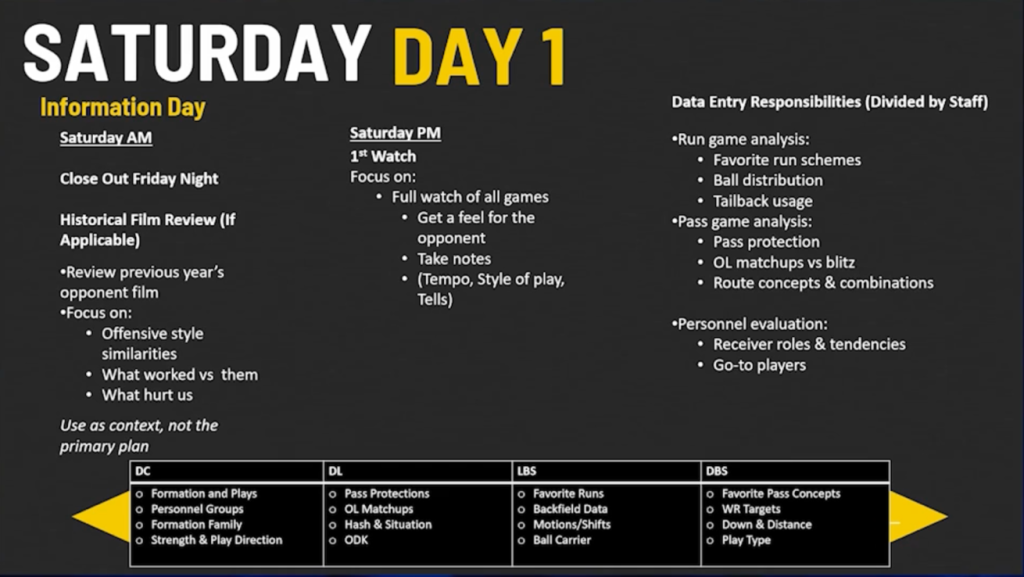
The workload is then divided among the coaching staff.
- The defensive coordinator handles formations and offensive plays.
- The defensive line coach studies protections and offensive line matchups.
- The linebackers coach focuses on the run game.
- The defensive backs coach analyzes the passing game and receiver tendencies.
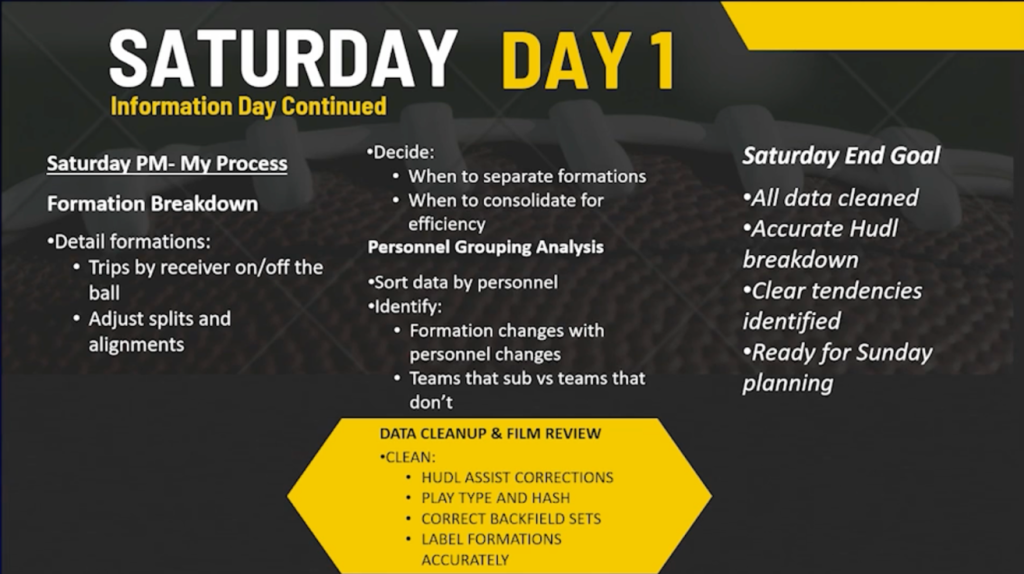
Ragland stressed the importance of clean data. Every run, pass, formation, hash mark, and situation must be entered correctly before searching for tendencies. If the information is inaccurate, the game plan built from that information will be inaccurate as well.
Sunday: Turn Information into a Plan
Sunday becomes the collaboration day.
After every coach completes their individual breakdown, the staff meets to compare notes and identify the offensive tendencies that matter most. The goal is not simply to collect information. It is finding the patterns that will influence the defensive call sheet.
From there, Chapel Hill builds its scouting report, creates practice scripts, draws scout cards, and installs the base defensive game plan for the week.
By the end of Sunday, the staff wants every piece of the foundation complete so Monday can focus entirely on teaching players instead of continuing staff preparation.
Monday: Prioritize Clarity Over Volume
Monday serves as installation day.
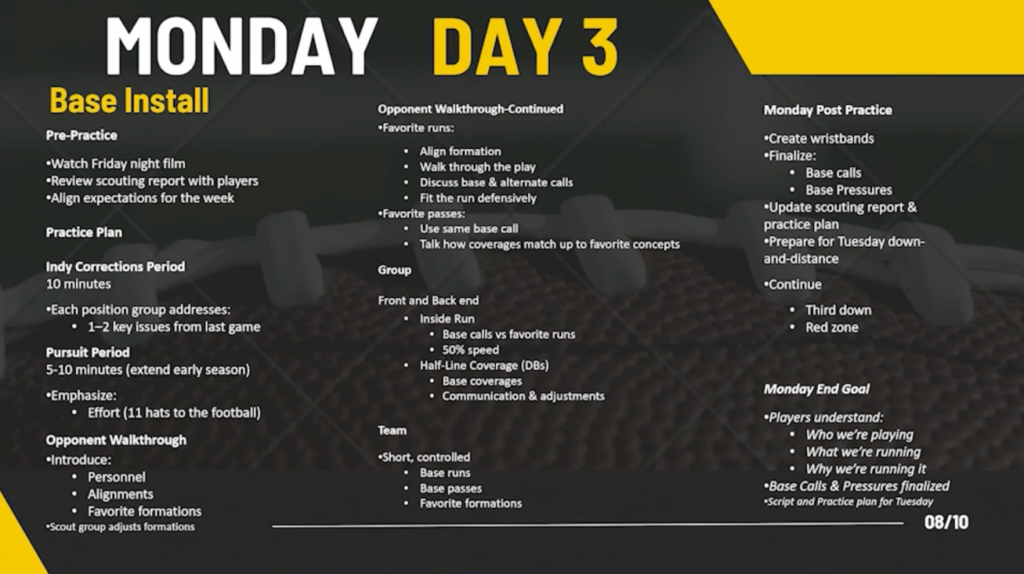
The objective at the end of Monday is for players to understand who the opponent is, what Chapel Hill plans to do defensively, and why each adjustment has been made. Explaining the reasoning behind the game plan increases player buy-in throughout the week.
Tuesday: Build Physical Confidence
Tuesday becomes the most physical practice of the week.
Before practice, the coaching staff finalizes practice scripts and uploads the completed scouting report. Chapel Hill also uses a lunch film session to reinforce opponent tendencies, review formations, and rehearse pre-snap communication before players ever step onto the practice field.
The pre-practice walkthrough focuses on unusual formations and automatic checks, so there are no surprises later in the week.
Practice opens with a team tackling and takeaway circuit. Coaches rotate players through multiple stations featuring angle tackling, strip drills, and ball disruption techniques while mixing drills throughout the season to keep players engaged.
Individual periods are designed around the specific challenges each position group expects to face against that week’s opponent. Every drill connects directly to the upcoming game rather than simply repeating generic fundamentals.
Wednesday: Pressure and Precision
Wednesday shifts the emphasis from physicality to execution.
Position groups begin with individual corrections and position-specific tackling drills before moving into a fast-paced blitz period. By this point in the week, players use wristbands to receive defensive calls, allowing the unit to practice game-day communication while increasing the tempo.
The defense then works through group periods that emphasize perimeter run fits before moving into seven-on-seven work focused on third-down passing situations.
Every team period is scripted around the situations Chapel Hill expects to face on Friday. Rather than practicing every possible scenario, the defense concentrates on the downs, distances, formations, and concepts that appear most frequently on the opponent’s film.
Thursday: Prepare to Play Fast
By Thursday, installation is complete.
The focus shifts to polishing execution, reviewing communication, and reinforcing confidence before kickoff. Every correction has already been made, every tendency has already been studied, and every situation has already been rehearsed.
Instead of introducing new concepts late in the week, Chapel Hill uses Thursday to make sure players can execute everything they have practiced throughout the week with speed and confidence.
Process Creates Confidence
One of the biggest takeaways from Ragland’s presentation was that effective game planning is less about creating the perfect call and more about building a repeatable weekly process.
Every day has a purpose. Every coach has a responsibility. Every practice period prepares players for a specific challenge they will face on Friday night.
By combining detailed film study, clearly defined staff responsibilities, organized practice planning, and consistent player communication, Chapel Hill has developed a weekly routine that allows its defense to play fast, eliminate explosive plays, and enter every game with confidence.
Become an AFCA member to access exclusive football coaching education, clinics, and resources.
🏈 AFCA Membership is open. Join thousands of football coaches committed to growing the game through the American Football Coaches Association.

For more information about the AFCA, visit www.AFCA.com. For more interesting articles, check out The Insider and subscribe to our weekly email.
If you are interested in more in-depth articles and videos, please become an AFCA member. You can find out more information about membership and specific member benefits on the AFCA Membership Overview page. If you are ready to join, please fill out the AFCA Membership Application.
« « Previous PostNext Post » »
Building an In-Season Defensive Game Plan from Saturday to Thursday
At the 2026 AFCA Convention, Chapel Hill (N.C.) High School Defensive Coordinator Dock Ragland shared the defensive game planning process his staff follows each week. Rather than focusing on scheme, Ragland centered his presentation on organization, communication, and building a weekly routine that allows players to play fast on Friday nights.
For Chapel Hill, every day has a defined purpose. Each practice and meeting builds on the previous one, creating a structured progression from evaluating the previous game to finalizing the game plan before kickoff.
Saturday: Close the Book and Begin the Next Chapter
Ragland emphasized that successful game plans begin immediately after Friday night’s game ends. Saturday starts with reviewing the previous game, making corrections, and evaluating performance before attention shifts to the next opponent.
The workload is then divided among the coaching staff.
- The defensive coordinator handles formations and offensive plays.
- The defensive line coach studies protections and offensive line matchups.
- The linebackers coach focuses on the run game.
- The defensive backs coach analyzes the passing game and receiver tendencies.
Ragland stressed the importance of clean data. Every run, pass, formation, hash mark, and situation must be entered correctly before searching for tendencies. If the information is inaccurate, the game plan built from that information will be inaccurate as well.
Sunday: Turn Information into a Plan
Sunday becomes the collaboration day.
After every coach completes their individual breakdown, the staff meets to compare notes and identify the offensive tendencies that matter most. The goal is not simply to collect information. It is finding the patterns that will influence the defensive call sheet.
From there, Chapel Hill builds its scouting report, creates practice scripts, draws scout cards, and installs the base defensive game plan for the week.
By the end of Sunday, the staff wants every piece of the foundation complete so Monday can focus entirely on teaching players instead of continuing staff preparation.
Monday: Prioritize Clarity Over Volume
Monday serves as installation day.
The objective at the end of Monday is for players to understand who the opponent is, what Chapel Hill plans to do defensively, and why each adjustment has been made. Explaining the reasoning behind the game plan increases player buy-in throughout the week.
Tuesday: Build Physical Confidence
Tuesday becomes the most physical practice of the week.
Before practice, the coaching staff finalizes practice scripts and uploads the completed scouting report. Chapel Hill also uses a lunch film session to reinforce opponent tendencies, review formations, and rehearse pre-snap communication before players ever step onto the practice field.
The pre-practice walkthrough focuses on unusual formations and automatic checks, so there are no surprises later in the week.
Practice opens with a team tackling and takeaway circuit. Coaches rotate players through multiple stations featuring angle tackling, strip drills, and ball disruption techniques while mixing drills throughout the season to keep players engaged.
Individual periods are designed around the specific challenges each position group expects to face against that week’s opponent. Every drill connects directly to the upcoming game rather than simply repeating generic fundamentals.
Wednesday: Pressure and Precision
Wednesday shifts the emphasis from physicality to execution.
Position groups begin with individual corrections and position-specific tackling drills before moving into a fast-paced blitz period. By this point in the week, players use wristbands to receive defensive calls, allowing the unit to practice game-day communication while increasing the tempo.
The defense then works through group periods that emphasize perimeter run fits before moving into seven-on-seven work focused on third-down passing situations.
Every team period is scripted around the situations Chapel Hill expects to face on Friday. Rather than practicing every possible scenario, the defense concentrates on the downs, distances, formations, and concepts that appear most frequently on the opponent’s film.
Thursday: Prepare to Play Fast
By Thursday, installation is complete.
The focus shifts to polishing execution, reviewing communication, and reinforcing confidence before kickoff. Every correction has already been made, every tendency has already been studied, and every situation has already been rehearsed.
Instead of introducing new concepts late in the week, Chapel Hill uses Thursday to make sure players can execute everything they have practiced throughout the week with speed and confidence.
Process Creates Confidence
One of the biggest takeaways from Ragland’s presentation was that effective game planning is less about creating the perfect call and more about building a repeatable weekly process.
Every day has a purpose. Every coach has a responsibility. Every practice period prepares players for a specific challenge they will face on Friday night.
By combining detailed film study, clearly defined staff responsibilities, organized practice planning, and consistent player communication, Chapel Hill has developed a weekly routine that allows its defense to play fast, eliminate explosive plays, and enter every game with confidence.
Become an AFCA member to access exclusive football coaching education, clinics, and resources.
🏈 AFCA Membership is open. Join thousands of football coaches committed to growing the game through the American Football Coaches Association.
For more information about the AFCA, visit www.AFCA.com. For more interesting articles, check out The Insider and subscribe to our weekly email.
If you are interested in more in-depth articles and videos, please become an AFCA member. You can find out more information about membership and specific member benefits on the AFCA Membership Overview page. If you are ready to join, please fill out the AFCA Membership Application.