Modern Tackling Reimagined: Movement & Precision
February 18, 2026
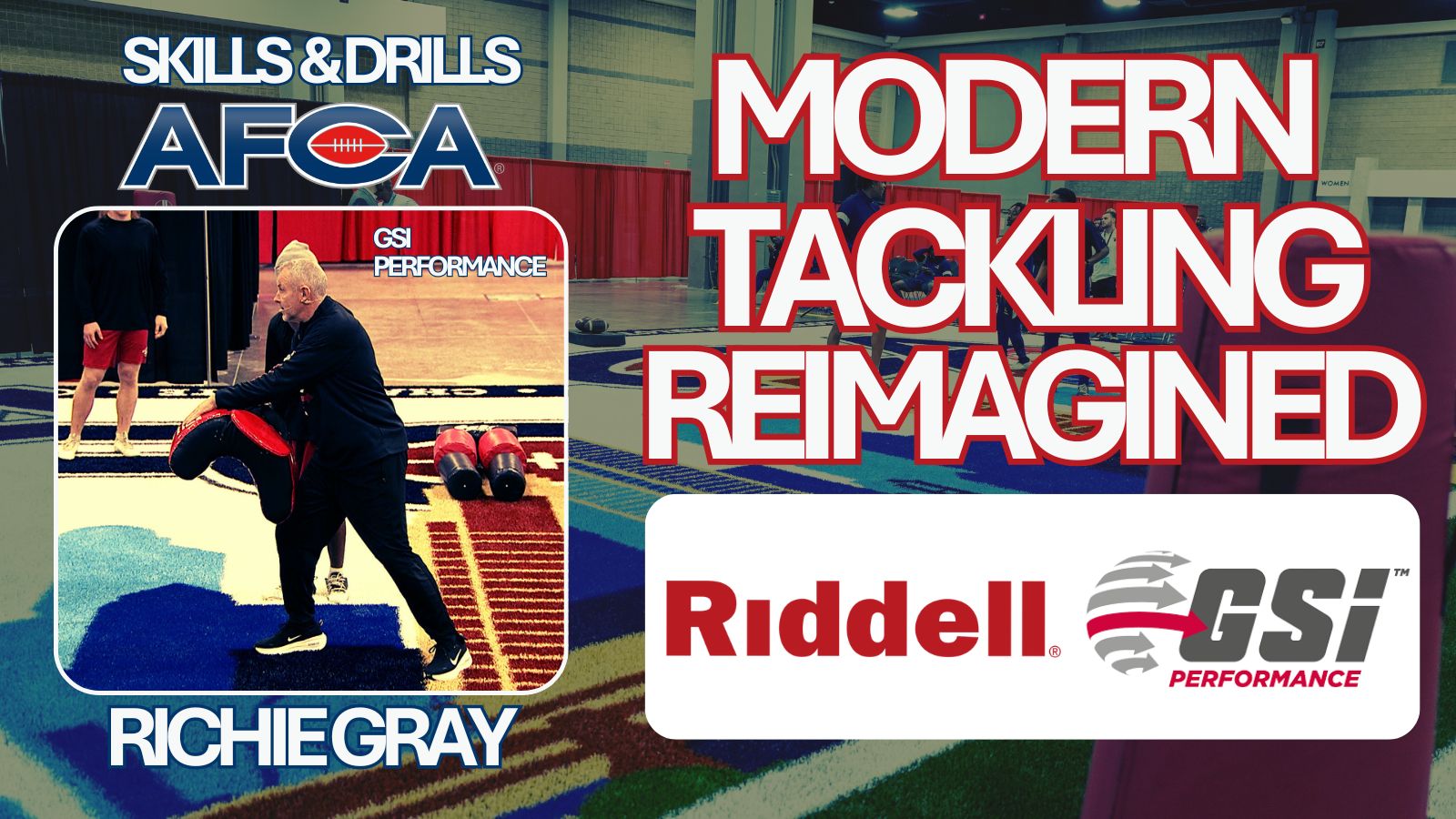
At the 2026 AFCA Convention, Riddell and Richie Gray from GSI Performance collaborated to deliver a comprehensive session on modern tackling techniques. Gray, whose system is now utilized by 26 of the 32 NFL teams, focused on the equipment and drills necessary to remove the “fallacy” of static training. His philosophy emphasizes that even when using dummies, coaches must create movement and pressure to simulate game-like scenarios.
The session was structured around specific equipment designed to target three distinct levels of tackling: Level 1 (Ankle to Knee), Level 2 (Knee to Hip), and Level 3 (Hip to Pectoral).
Part 1: Bag Drills (Levels 1 & 3)
Gray began with drills utilizing standard GSI tackle bags, focusing on entry points, grip, and leg drive.
Drill: The “Up-Down” and Drive (Level 1)
This drill challenges a player’s ability to recover from the ground and immediately make a low-level tackle while maintaining leverage.
A player starts with an “up-down” (dropping to the chest and popping up). Gray instructs them to “stay loaded” (keep their center of gravity low) upon rising.
As the player rises, the coach walks the Level 1 bag into them. The player must execute a same-foot/same-shoulder hit and drive the bag backward.
Gray emphasized chasing the feet after contact and securing a tight wrap on the grip bar. The goal is to drive the feet “down the hill” rather than stopping at the point of impact.
Drill: Timing and Angles (Level 3)
Using the heavier “Senior” Level 3 bag, this drill introduces timing and lateral movement.
The bag is moved on counts one and two, then thrown at the player on count three.
The player must track the bag and time their entry to get underneath the target, wrapping tight with elbows in and wrists above elbows. Variations: To increase difficulty, players perform an up-down before the bag is thrown at an angle, forcing them to coil like a spring and drive through the moving target.
Drill: The Drive & Roll
Similar to the first drill, the coach runs the Level 1 bag at the player. The player drives the bag back first to stop momentum, then executes a fast roll to finish on top of the bag.
Gray stressed the importance of a “fast roll” only after the initial drive back is established.
Part 2: The Dip and Rise Shield
Gray addressed common misuse of the “Dip and Rise” shield, correcting the holding technique to prevent injury and improve drill utility.
Drill: Hip Sink and Punch Through
The holder must stand in a strong, braced position using the shield’s loops properly to protect their head and elbows.
The tackler approaches, drops their height (“hip sink”), and fires through the shield.
The focus is on “punching through” with the arms rather than having “flying arms.” The tackler must squeeze the shield tightly and “drive for five” steps to finish. Gray emphasized keeping the head tight to the side to avoid loose head placement.
Part 3: The Tackle Legs (New Equipment)
The final portion of the session introduced “Tackle Legs”—articulated equipment weighing approximately 30 lbs (but striking with 3x the force when driven by a coach) designed to simulate the difficulty of wrapping moving legs.
Drill: Cylinder Clamp Control
A coach runs the tackle legs toward the player.
The player must drop their height early, make shoulder contact, and aggressively clamp the two red thigh cylinders together.
The primary goal is to remove the space between the legs. If the player fails to clamp effectively, the legs will fly apart, simulating a broken tackle.
Drill: Angle and Gator Roll
The coach moves the legs at an angle across the player’s face.
The player connects and executes a “gator roll” to take the legs to the ground in the direction of momentum.
Drill: Continuous Partner Drill
Players group in threes. One player runs the legs, one tackles, and they cycle through continuously. The coach can cycle through variations (up-down, angles, etc.).
Players practice “lifting” the legs slightly upon contact to disrupt balance while keeping their cleats driving in the grass.
Gray stressed “staying loaded” between the up-down and the tackle. Rising too high exposes the tackler to being beaten by the moving legs.
Conclusion:
Gray concluded by discussing the integration of on-field drills with modern technology, such as Insight helmets. He likened the use of data to a “prescription,” where the drills serve as the “medicine” to correct issues found in the analytics. By focusing on individual accuracy and micro-skills like “clamping the cylinders” and “chasing feet”, coaches can build a safer, more effective defensive tackling.
Watch The Full Video Here:
2026 Convention Skills & Drills Are Now Live: CLICK HERE
As you prepare for Spring Ball, don’t stop with just one session. All 2026 Skills & Drills presentations from the AFCA Convention are now available in the AFCA Digital Library. AFCA members can log in to watch this tackling system in full, along with hundreds of additional position-specific sessions designed to help you build practice plans, install new drills, and sharpen fundamentals across your program.
If you’re looking to maximize your spring practice efficiency, the AFCA Digital Library is your year-round resource for proven drills, clinic tape, and coaching insight from every level of the game. Log in today and start building your Spring Ball practice script.
For more information about the AFCA, visit www.AFCA.com. For more interesting articles, check out The Insider and subscribe to our weekly email.
If you are interested in more in-depth articles and videos, please become an AFCA member. You can find out more information about membership and specific member benefits on the AFCA Membership Overview page. If you are ready to join, please fill out the AFCA Membership Application.
« « Previous PostNext Post » »
At the 2026 AFCA Convention, Riddell and Richie Gray from GSI Performance collaborated to deliver a comprehensive session on modern tackling techniques. Gray, whose system is now utilized by 26 of the 32 NFL teams, focused on the equipment and drills necessary to remove the “fallacy” of static training. His philosophy emphasizes that even when using dummies, coaches must create movement and pressure to simulate game-like scenarios.
The session was structured around specific equipment designed to target three distinct levels of tackling: Level 1 (Ankle to Knee), Level 2 (Knee to Hip), and Level 3 (Hip to Pectoral).
Part 1: Bag Drills (Levels 1 & 3)
Gray began with drills utilizing standard GSI tackle bags, focusing on entry points, grip, and leg drive.
Drill: The “Up-Down” and Drive (Level 1)
This drill challenges a player’s ability to recover from the ground and immediately make a low-level tackle while maintaining leverage.
A player starts with an “up-down” (dropping to the chest and popping up). Gray instructs them to “stay loaded” (keep their center of gravity low) upon rising.
As the player rises, the coach walks the Level 1 bag into them. The player must execute a same-foot/same-shoulder hit and drive the bag backward.
Gray emphasized chasing the feet after contact and securing a tight wrap on the grip bar. The goal is to drive the feet “down the hill” rather than stopping at the point of impact.
Drill: Timing and Angles (Level 3)
Using the heavier “Senior” Level 3 bag, this drill introduces timing and lateral movement.
The bag is moved on counts one and two, then thrown at the player on count three.
The player must track the bag and time their entry to get underneath the target, wrapping tight with elbows in and wrists above elbows. Variations: To increase difficulty, players perform an up-down before the bag is thrown at an angle, forcing them to coil like a spring and drive through the moving target.
Drill: The Drive & Roll
Similar to the first drill, the coach runs the Level 1 bag at the player. The player drives the bag back first to stop momentum, then executes a fast roll to finish on top of the bag.
Gray stressed the importance of a “fast roll” only after the initial drive back is established.
Part 2: The Dip and Rise Shield
Gray addressed common misuse of the “Dip and Rise” shield, correcting the holding technique to prevent injury and improve drill utility.
Drill: Hip Sink and Punch Through
The holder must stand in a strong, braced position using the shield’s loops properly to protect their head and elbows.
The tackler approaches, drops their height (“hip sink”), and fires through the shield.
The focus is on “punching through” with the arms rather than having “flying arms.” The tackler must squeeze the shield tightly and “drive for five” steps to finish. Gray emphasized keeping the head tight to the side to avoid loose head placement.
Part 3: The Tackle Legs (New Equipment)
The final portion of the session introduced “Tackle Legs”—articulated equipment weighing approximately 30 lbs (but striking with 3x the force when driven by a coach) designed to simulate the difficulty of wrapping moving legs.
Drill: Cylinder Clamp Control
A coach runs the tackle legs toward the player.
The player must drop their height early, make shoulder contact, and aggressively clamp the two red thigh cylinders together.
The primary goal is to remove the space between the legs. If the player fails to clamp effectively, the legs will fly apart, simulating a broken tackle.
Drill: Angle and Gator Roll
The coach moves the legs at an angle across the player’s face.
The player connects and executes a “gator roll” to take the legs to the ground in the direction of momentum.
Drill: Continuous Partner Drill
Players group in threes. One player runs the legs, one tackles, and they cycle through continuously. The coach can cycle through variations (up-down, angles, etc.).
Players practice “lifting” the legs slightly upon contact to disrupt balance while keeping their cleats driving in the grass.
Gray stressed “staying loaded” between the up-down and the tackle. Rising too high exposes the tackler to being beaten by the moving legs.
Conclusion:
Gray concluded by discussing the integration of on-field drills with modern technology, such as Insight helmets. He likened the use of data to a “prescription,” where the drills serve as the “medicine” to correct issues found in the analytics. By focusing on individual accuracy and micro-skills like “clamping the cylinders” and “chasing feet”, coaches can build a safer, more effective defensive tackling.
Watch The Full Video Here:
2026 Convention Skills & Drills Are Now Live: CLICK HERE
As you prepare for Spring Ball, don’t stop with just one session. All 2026 Skills & Drills presentations from the AFCA Convention are now available in the AFCA Digital Library. AFCA members can log in to watch this tackling system in full, along with hundreds of additional position-specific sessions designed to help you build practice plans, install new drills, and sharpen fundamentals across your program.
If you’re looking to maximize your spring practice efficiency, the AFCA Digital Library is your year-round resource for proven drills, clinic tape, and coaching insight from every level of the game. Log in today and start building your Spring Ball practice script.
For more information about the AFCA, visit www.AFCA.com. For more interesting articles, check out The Insider and subscribe to our weekly email.
If you are interested in more in-depth articles and videos, please become an AFCA member. You can find out more information about membership and specific member benefits on the AFCA Membership Overview page. If you are ready to join, please fill out the AFCA Membership Application.