Maximizing LB Individual Drills in Condensed Timelines
June 17, 2026
At the 2026 American Football Coaches Association (AFCA) Convention in Charlotte, North Carolina, USC Coach AJ Howard delivered a presentation titled “Maximizing Individual Drills,” which addresses a challenge faced by coaching staffs at all levels: less and less Indy time as the season goes along.
The Philosophy of Efficiency: Time vs. Progression
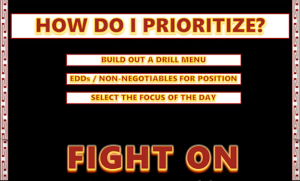
Coach Howard’s core premise centers around the realities of the practice clock. During fall camp, a position coach might enjoy a 22-minute block for individual drills. However, by week eight or nine of the regular season, that window is 10 minutes. According to Howard, it is impossible to squeeze a comprehensive technique catalog into such a tight window without a highly organized, deliberate framework. He champions a systematic approach: building a structured “drill menu” composed of non-negotiable Every Day Drills (EDDs) and selecting a specific focus for each practice day.
The Four Pillars of the Linebacker Drill Menu
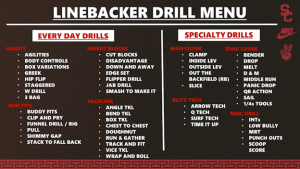
For the linebacker position, Coach Howard isolates four non-negotiables that require daily practice to establish fundamental soundness: agility, run fits, defeating blocks, and tackling. While specialty areas like coverage adjustments and turnover creation are done in specific practice segments. In Howard’s system, a coach must select one foundational element from each section daily.
Foundational Every Day Drills (EDDs)
To demonstrate these concepts, Coach Howard detailed three signature drills designed to optimize player movement patterns, body positioning, and reaction speeds:
- The EDD Lateral Shuffle Drill
- Objective: Reinforce proper knee bend, maintain square shoulders, and develop the ability to gain lateral ground without crossing the feet over in the box.
- Setup: Nine agile bags arranged in three distinct rows of three bags each.
- Execution: Linebackers accelerate toward the coach, execute a controlled deceleration to showcase balance, and shuffle laterally down the bag line with their eyes up. The drill concludes with a vertical trigger toward a thrown ball or a physical runner.
- Variations: Coaches can utilize a live runner moving at 45-degree or 90-degree angles to alter the launch point, training players to finish decisively as tacklers rather than passive ball catchers.
- The Run and Gather Drill
- Objective: Train the mechanical transition from a full-speed, lateral sprint to a balanced, square, and controlled shuffle at the immediate point of attack.
- Setup: Five cones are placed exactly five yards apart along a linear path.
- Execution: Players open into a high-speed sprint across the cones. Upon an auditory or visual command (such as a whistle or a verbal cue), they must instantly drop their hips and gather into a lateral shuffle, keeping their eyes locked on the target hip.
- Progression: The drill can be adapted to a tight space at the goal line where the linebacker directly keys the coach or a live running back’s hip, mirroring the ball carrier’s angles and squaring up instantly when the runner squares up.
- The Down and Away Block Shed Drill
- Objective: Simulate striking an offensive blocker in the chest, locking out the arms, and violently disengaging from the block.
- Setup: Can utilize a U-sled, hand shields, pop-up dummies, or a live offensive player.
- Execution: Linebackers strike the target with thumbs up and eyes above their hands, bringing their hips completely through the contact. They must violently pull the blocker down and away from their frame to clear the hands.
- Finishing Options: The drill can finish on a landing pad, a tackle donut, a live moving target, or can be combined with a high elbow punch down to force a fumble. Howard notes that practicing from a negative or disadvantaged alignment simulates tight ends climbing to the second level.
The Space Tackling Framework
Howard emphasizes that open space tackling remains the most difficult skill to execute consistently on defense. His space tackling drill utilizes two cones solely for initial alignment, allowing coaches to vary the distance from 5 to 20 yards depending on the emphasis.
The non-negotiable coaching points are highly specific: players must utilize a long stride to close distance rapidly, transition to a short stride to break down, burn their eyes into the ball carrier’s near hip, and tag off or wrap up with palms facing up. Howard notes that palms facing up naturally force the defender to grab the jersey cloth and secure the stop. He recommends using a hula hoop around a stationary target during introductory phases to force players to step on the runner’s toes rather than lunging from a distance.
The Shimmy Fit and Strategic Day Focus
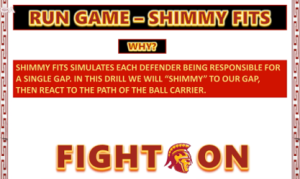
When transitioning from baseline EDDs to the specific focus of the day, Howard highlighted the “Shimmy Fit” drill to teach structured gap responsibility. Simulating an offensive line using five cones or pop-up targets, the drill establishes single gap accountability. The linebacker aligned to the side of the running back is trained to aggressively shoot his gap and play the ball. The backside linebacker must shimmy and stack his respective gap first, securing internal leverage before reacting to the ball carrier’s path. This prevents cutbacks and instills proper run fit discipline.
Coach Howard demonstrated how these individual tools dictate execution in coverage. Focusing on match quarters scheme work, he detailed specific rules for second-level drop defenders. For five-yard out routes, defenders are coached to “chase it, don’t beat it,” conceding the flat throw to prevent an offensive target from crossing their face. On ten-yard out routes, linebackers must actively press into the route to prevent the safety from breaking his deep alignment. On vertical routes, defenders must aggressively reroute the receiver and “pack the paint,” meaning they protect the seam area and push the route wider to allow the safety to maintain optimal vertical separation.
Coach AJ Howard’s presentation provided a blueprint for maximizing drill work with limited individual time. By ensuring that every movement pattern in a drill directly mirrors a game day scenario, coaches can cultivate intuitive, sound habits. His structured drill menu concept provides any coach with a practical method to preserve structural progression, streamline technique instruction, and sustain premium execution from the initial repetitions of August camp through the final whistle of the regular season.
AFCA 2027 Registration Opens July 1
Don’t forget to join or renew or join when our membership period opens on July 1st. Join the thousands of coaches at the AFCA Convention, February 14-16, 2027, in Indianapolis, IN.

For more information about the AFCA, visit www.AFCA.com. For more interesting articles, check out The Insider and subscribe to our weekly email.
If you are interested in more in-depth articles and videos, please become an AFCA member. You can find out more information about membership and specific member benefits on the AFCA Membership Overview page. If you are ready to join, please fill out the AFCA Membership Application.
« « Previous PostNext Post » »
At the 2026 American Football Coaches Association (AFCA) Convention in Charlotte, North Carolina, USC Coach AJ Howard delivered a presentation titled “Maximizing Individual Drills,” which addresses a challenge faced by coaching staffs at all levels: less and less Indy time as the season goes along.
The Philosophy of Efficiency: Time vs. Progression
Coach Howard’s core premise centers around the realities of the practice clock. During fall camp, a position coach might enjoy a 22-minute block for individual drills. However, by week eight or nine of the regular season, that window is 10 minutes. According to Howard, it is impossible to squeeze a comprehensive technique catalog into such a tight window without a highly organized, deliberate framework. He champions a systematic approach: building a structured “drill menu” composed of non-negotiable Every Day Drills (EDDs) and selecting a specific focus for each practice day.
The Four Pillars of the Linebacker Drill Menu
For the linebacker position, Coach Howard isolates four non-negotiables that require daily practice to establish fundamental soundness: agility, run fits, defeating blocks, and tackling. While specialty areas like coverage adjustments and turnover creation are done in specific practice segments. In Howard’s system, a coach must select one foundational element from each section daily.
Foundational Every Day Drills (EDDs)
To demonstrate these concepts, Coach Howard detailed three signature drills designed to optimize player movement patterns, body positioning, and reaction speeds:
- The EDD Lateral Shuffle Drill
- Objective: Reinforce proper knee bend, maintain square shoulders, and develop the ability to gain lateral ground without crossing the feet over in the box.
- Setup: Nine agile bags arranged in three distinct rows of three bags each.
- Execution: Linebackers accelerate toward the coach, execute a controlled deceleration to showcase balance, and shuffle laterally down the bag line with their eyes up. The drill concludes with a vertical trigger toward a thrown ball or a physical runner.
- Variations: Coaches can utilize a live runner moving at 45-degree or 90-degree angles to alter the launch point, training players to finish decisively as tacklers rather than passive ball catchers.
- The Run and Gather Drill
- Objective: Train the mechanical transition from a full-speed, lateral sprint to a balanced, square, and controlled shuffle at the immediate point of attack.
- Setup: Five cones are placed exactly five yards apart along a linear path.
- Execution: Players open into a high-speed sprint across the cones. Upon an auditory or visual command (such as a whistle or a verbal cue), they must instantly drop their hips and gather into a lateral shuffle, keeping their eyes locked on the target hip.
- Progression: The drill can be adapted to a tight space at the goal line where the linebacker directly keys the coach or a live running back’s hip, mirroring the ball carrier’s angles and squaring up instantly when the runner squares up.
- The Down and Away Block Shed Drill
- Objective: Simulate striking an offensive blocker in the chest, locking out the arms, and violently disengaging from the block.
- Setup: Can utilize a U-sled, hand shields, pop-up dummies, or a live offensive player.
- Execution: Linebackers strike the target with thumbs up and eyes above their hands, bringing their hips completely through the contact. They must violently pull the blocker down and away from their frame to clear the hands.
- Finishing Options: The drill can finish on a landing pad, a tackle donut, a live moving target, or can be combined with a high elbow punch down to force a fumble. Howard notes that practicing from a negative or disadvantaged alignment simulates tight ends climbing to the second level.
The Space Tackling Framework
Howard emphasizes that open space tackling remains the most difficult skill to execute consistently on defense. His space tackling drill utilizes two cones solely for initial alignment, allowing coaches to vary the distance from 5 to 20 yards depending on the emphasis.
The non-negotiable coaching points are highly specific: players must utilize a long stride to close distance rapidly, transition to a short stride to break down, burn their eyes into the ball carrier’s near hip, and tag off or wrap up with palms facing up. Howard notes that palms facing up naturally force the defender to grab the jersey cloth and secure the stop. He recommends using a hula hoop around a stationary target during introductory phases to force players to step on the runner’s toes rather than lunging from a distance.
The Shimmy Fit and Strategic Day Focus
When transitioning from baseline EDDs to the specific focus of the day, Howard highlighted the “Shimmy Fit” drill to teach structured gap responsibility. Simulating an offensive line using five cones or pop-up targets, the drill establishes single gap accountability. The linebacker aligned to the side of the running back is trained to aggressively shoot his gap and play the ball. The backside linebacker must shimmy and stack his respective gap first, securing internal leverage before reacting to the ball carrier’s path. This prevents cutbacks and instills proper run fit discipline.
Coach Howard demonstrated how these individual tools dictate execution in coverage. Focusing on match quarters scheme work, he detailed specific rules for second-level drop defenders. For five-yard out routes, defenders are coached to “chase it, don’t beat it,” conceding the flat throw to prevent an offensive target from crossing their face. On ten-yard out routes, linebackers must actively press into the route to prevent the safety from breaking his deep alignment. On vertical routes, defenders must aggressively reroute the receiver and “pack the paint,” meaning they protect the seam area and push the route wider to allow the safety to maintain optimal vertical separation.
Coach AJ Howard’s presentation provided a blueprint for maximizing drill work with limited individual time. By ensuring that every movement pattern in a drill directly mirrors a game day scenario, coaches can cultivate intuitive, sound habits. His structured drill menu concept provides any coach with a practical method to preserve structural progression, streamline technique instruction, and sustain premium execution from the initial repetitions of August camp through the final whistle of the regular season.
AFCA 2027 Registration Opens July 1
Don’t forget to join or renew or join when our membership period opens on July 1st. Join the thousands of coaches at the AFCA Convention, February 14-16, 2027, in Indianapolis, IN.
For more information about the AFCA, visit www.AFCA.com. For more interesting articles, check out The Insider and subscribe to our weekly email.
If you are interested in more in-depth articles and videos, please become an AFCA member. You can find out more information about membership and specific member benefits on the AFCA Membership Overview page. If you are ready to join, please fill out the AFCA Membership Application.