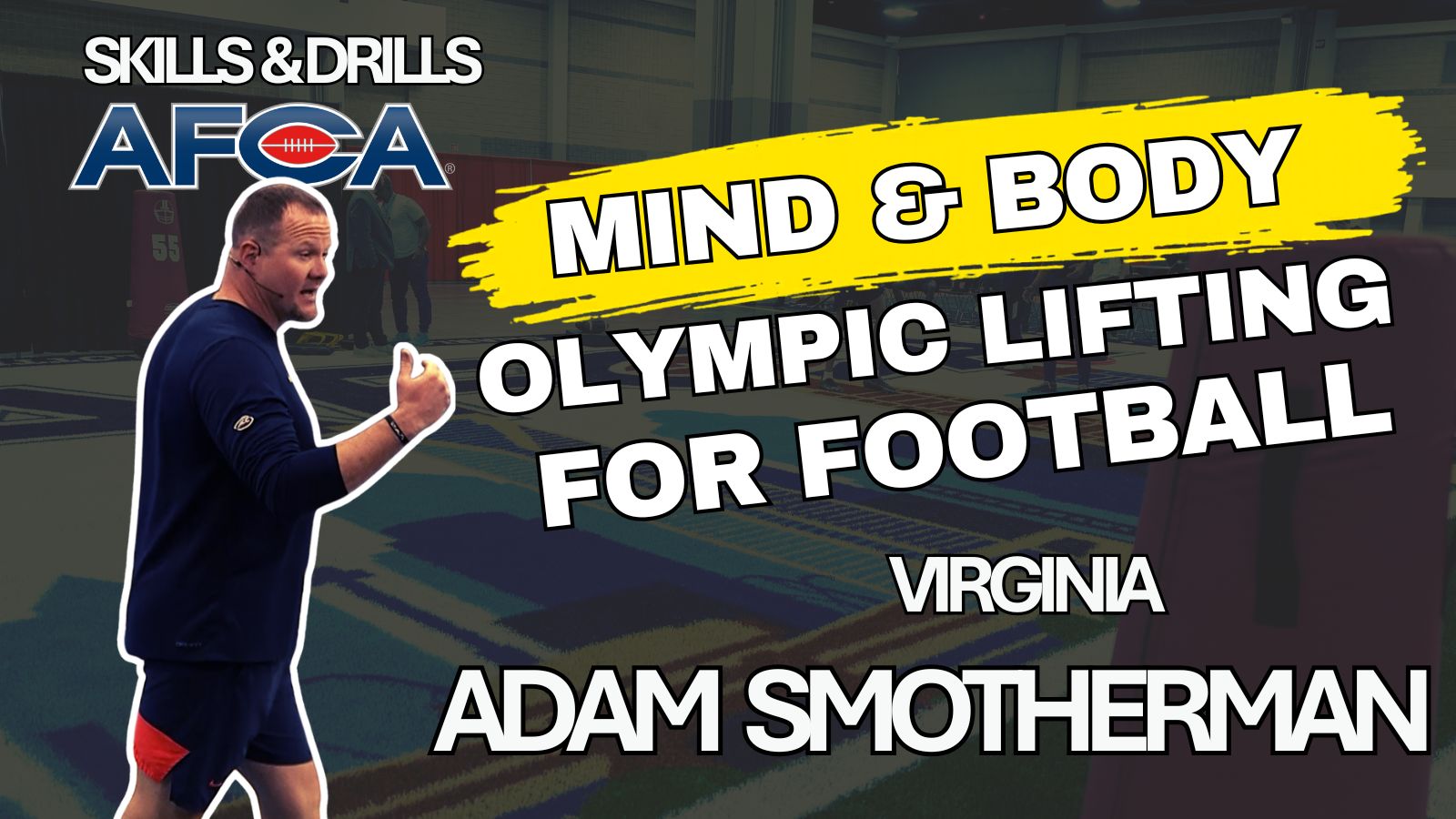
Building a Callous Mind and Body: Olympic Lifting for Football
May 27, 2026
At the University of Virginia, Head Football Strength and Conditioning Coach Adam Smotherman knows that preparing players for a long season means getting them ready for a series of repeated “car crashes”.
During the 2026 AFCA Convention, Coach Smotherman talked about how his program relies on Olympic lifting as a crucial tool for developing both force production and force absorption. Because the lifts mimic the natural extension patterns players use when sprinting or firing off the ball, they offer unparalleled benefits for on-field performance. Beyond the physical gains, the inherent difficulty of Olympic lifting helps develop the “callous mind and a callous body” required to survive the gridiron.
Step Zero: Do No Harm
Before any athlete touches a barbell, the golden rule of the weight room is to “do no harm”. Every player must pass a rigorous movement screen evaluating ankle, hip, and shoulder mobility, as well as knee stability. If an athlete cannot perform a basic bodyweight squat without their heels lifting, or if they cannot hold a plank for 30 seconds, they are assigned foundational exercises before advancing to Olympic lifts.
The Methodical Progression
Once cleared, athletes learn to safely address the bar using a vertical jump stance and must set their “trunk”—the entire cylinder of muscles from the lower chest to the mid-thighs—to protect their spine. Rather than jumping straight into heavy weights, the training follows a step-by-step progression:
- The Liftoff: Athletes practice lifting the bar just below the knee, allowing coaches to spot and correct weaknesses like a rounding back or shifting knees.
- The First Push: Connecting the weight room to the field, athletes learn to push their feet into the ground to accelerate the bar, using the popular coaching cue “Push, jump, punch”.
- The Catch: Because players practice front squats concurrently, they are comfortable violently punching their elbows under the bar to safely rack the weight across their shoulders in a power position.
Adaptations for the Athlete
Because the weight room is a means to an end, the program is highly adaptable. If an older or injured player lacks the mobility to safely catch a clean or perform a front squat, they should never be forced to do so. Instead, they perform explosive clean pulls from the floor, immediately followed by half-depth squats in a rack using straps. This ensures they still reap the benefits of training force absorption without risking a dangerous setback. Ultimately, this progression is designed to safely build better men first, and better football players second.
2026 Convention Skills & Drills Are Now Live: CLICK HERE

For more information about the AFCA, visit www.AFCA.com. For more interesting articles, check out The Insider and subscribe to our weekly email.
If you are interested in more in-depth articles and videos, please become an AFCA member. You can find out more information about membership and specific member benefits on the AFCA Membership Overview page. If you are ready to join, please fill out the AFCA Membership Application.
« « Previous PostNext Post » »
At the University of Virginia, Head Football Strength and Conditioning Coach Adam Smotherman knows that preparing players for a long season means getting them ready for a series of repeated “car crashes”.
During the 2026 AFCA Convention, Coach Smotherman talked about how his program relies on Olympic lifting as a crucial tool for developing both force production and force absorption. Because the lifts mimic the natural extension patterns players use when sprinting or firing off the ball, they offer unparalleled benefits for on-field performance. Beyond the physical gains, the inherent difficulty of Olympic lifting helps develop the “callous mind and a callous body” required to survive the gridiron.
Step Zero: Do No Harm
Before any athlete touches a barbell, the golden rule of the weight room is to “do no harm”. Every player must pass a rigorous movement screen evaluating ankle, hip, and shoulder mobility, as well as knee stability. If an athlete cannot perform a basic bodyweight squat without their heels lifting, or if they cannot hold a plank for 30 seconds, they are assigned foundational exercises before advancing to Olympic lifts.
The Methodical Progression
Once cleared, athletes learn to safely address the bar using a vertical jump stance and must set their “trunk”—the entire cylinder of muscles from the lower chest to the mid-thighs—to protect their spine. Rather than jumping straight into heavy weights, the training follows a step-by-step progression:
- The Liftoff: Athletes practice lifting the bar just below the knee, allowing coaches to spot and correct weaknesses like a rounding back or shifting knees.
- The First Push: Connecting the weight room to the field, athletes learn to push their feet into the ground to accelerate the bar, using the popular coaching cue “Push, jump, punch”.
- The Catch: Because players practice front squats concurrently, they are comfortable violently punching their elbows under the bar to safely rack the weight across their shoulders in a power position.
Adaptations for the Athlete
Because the weight room is a means to an end, the program is highly adaptable. If an older or injured player lacks the mobility to safely catch a clean or perform a front squat, they should never be forced to do so. Instead, they perform explosive clean pulls from the floor, immediately followed by half-depth squats in a rack using straps. This ensures they still reap the benefits of training force absorption without risking a dangerous setback. Ultimately, this progression is designed to safely build better men first, and better football players second.
For more information about the AFCA, visit www.AFCA.com. For more interesting articles, check out The Insider and subscribe to our weekly email.
If you are interested in more in-depth articles and videos, please become an AFCA member. You can find out more information about membership and specific member benefits on the AFCA Membership Overview page. If you are ready to join, please fill out the AFCA Membership Application.