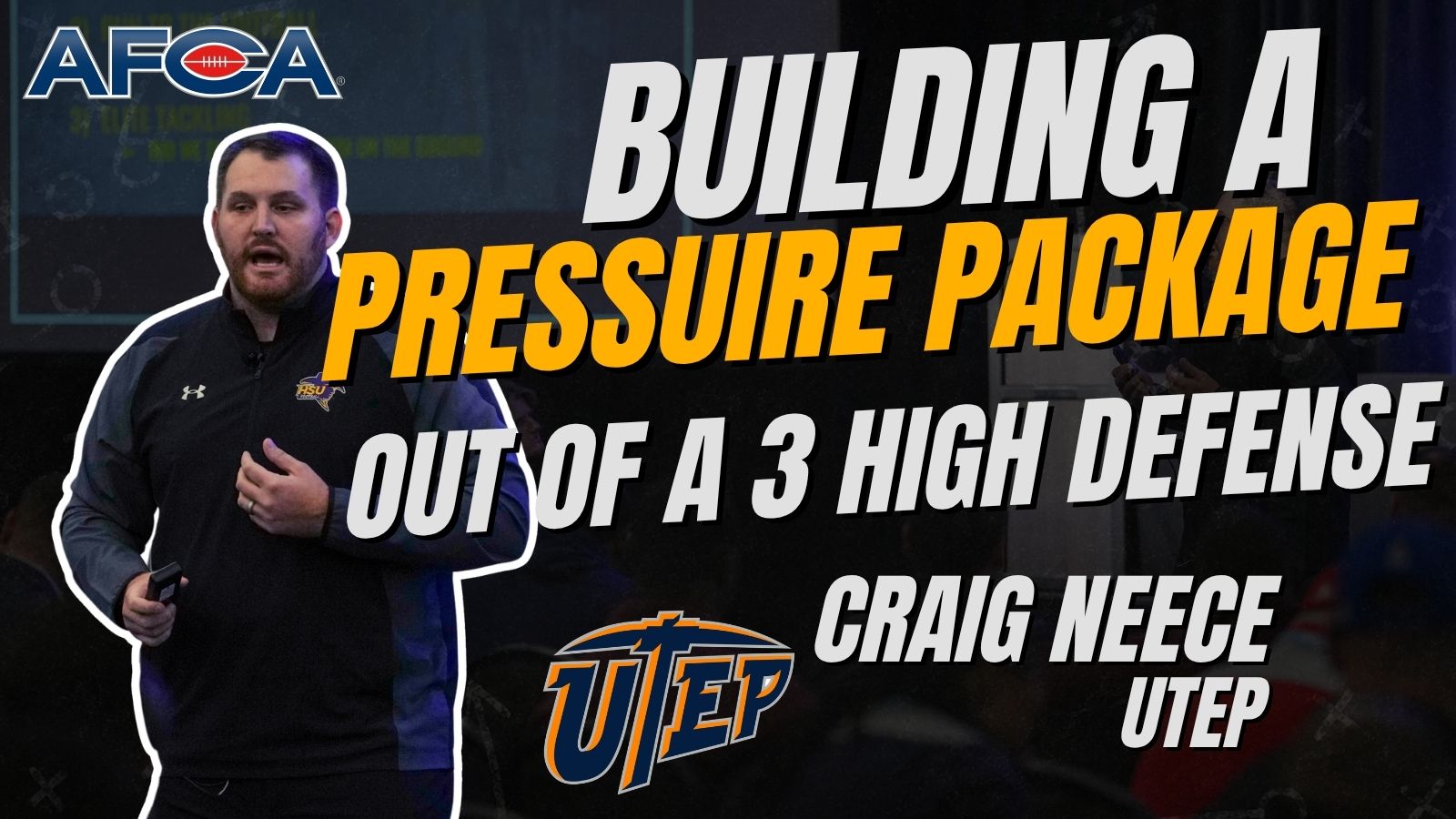
Building Pressure Packages Out of A 3-High Defense
June 9, 2026
Building an effective defensive pressure package from the ground up requires finding a middle ground. Strategies should neither be too simplistic to teach effectively nor too complex for players to execute fast. For Craig Neece, the Outside Linebackers Coach at UTEP, a successful pressure system is not defined by what is drawn on a whiteboard, but by the specific identity that shows up on film.
Whether a coach is taking over a new program or entering their first year in a system, the package must be rooted in foundational pillars. The 3-high safety structure allows a defense to dictate the flow of the game, stop the run, and force opposing offenses to adjust to the defense.
The Core Defensive Philosophy
The Three-Step Alignment
Borrowing a framework from former Mount Union head coach Vince Kehres, the defensive building process is filtered through three distinct categories: players, formations, and plays.
- Players: The primary goal is putting the best 11 defenders on the field. A high-performing player should never sit on the bench simply because they do not fit a rigid scheme; the scheme must be tailored to the roster.
- Formations: The defense must run the structural look that players execute best. While Neece operated in a traditional 4-2-5 system for a long time, the current roster’s strengths aligned with a 3-high safety alignment.
- Plays: Coaches must isolate the situations and techniques their players do well and put them in those positions repeatedly.
Analytical Objectives
The foundation of the scheme relies on stopping the run and forcing offenses to earn the right to pass. If an opponent can pick up easy yardage on the ground, it creates a long afternoon for the defense.
Beyond stopping the run, the ultimate objective is to create constant havoc to take control of the game tempo. While offensive coordinators frequently preach that their tempo dictates the flow of the game, this pressure philosophy is designed to force the offense to adjust.
Defining the Defensive Identity
The execution of the package is evaluated through traits that players can control completely: attitude and effort. Those two factors are mandatory expectations the moment players enter the facility.
These traits are verified through specific daily expectations:
Pursuit Requirements
Pursuit is drilled every single day. A player’s attitude and mindset can be read immediately by their willingness to sprint and swarm to the football. Even an All-American will be benched if they refuse to run to the ball. Chasing down plays from behind turns potential touchdowns into turnovers, a reality that shows up on tape.
Physical Tackling Standards
The program sets a standard to win the tackling margin every Saturday. Simply dragging a ball carrier down as they gain positive yards or fall forward is not deemed an acceptable tackle. A true tackle requires stopping the opponent dead in their tracks or driving them backward. The defense must remain the aggressor.
The Factual Performance Checklist
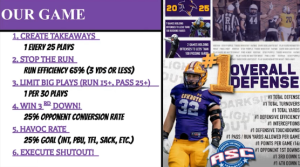
Rather than chasing vague goals, the defensive unit uses hard data to track efficiency across six primary categories:
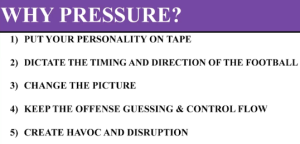
Why Pressure Out of the 3-High?
Many defensive structures are content sitting in a standard 4-2-5 quarter-match coverage look week after week, relying on a small menu of plays. This system rejects that passive approach. Pressuring out of a 3-high look allows a defense to present a static, identical pre-snap picture while completely shifting the look post-snap. This constant variation forces the quarterback to hesitate and play on his heels.
The 3-high alignment is particularly effective because it provides structural balance against modern offensive gimmicks. When an offense uses heavy motion, shifts, or unusual formations, the 3-high structure allows the defense to cancel out those adjustments using five secondary players. The defense can play balanced numbers at all times rather than adjusting to strength identifiers.
Building the Pressure Package
When constructing this system or planning for an upcoming opponent, the installation is filtered through this process:
- Know the Personnel
Coaches must analyze their own roster along with the opponent’s personnel. The strategy must highlight defensive strengths and avoid areas of weakness. If an opponent struggles with a concept that the defense cannot execute well, it is left off the call sheet. Sub-packages are used extensively to rotate players and maximize depth.
- Establish Safety Variables
The defensive staff determines early on how involved the safeties will be in the pressure scheme. This does not strictly imply blitzing, but rather refers to their coverage depth and underneath responsibilities. Pressures are drawn from the back-end coverage forward, so the system is never restricted by the front alignment.
- Identify Opponent Tendencies
If a defense struggles with a certain play, they will see it repeatedly. The same logic applies to offenses: if the film shows an offensive line struggling to pick up a specific pressure, that pressure becomes a primary weapon. Cutups are scrutinized to find concepts that produce sacks and TFLs.
- Ensure Dynamic Adaptability
A blitz is useless if the defense must check out of the play the moment an offense moves to empty, a tight end set, or a 3×1 formation. Pressure paths must be designed to work against any personnel grouping or formation.
Coaching Insight: A common misconception is that a 3-high safety look forces a team to play an odd front. By adjusting the front six players, the defense can easily transition into four-down, five-down, or six-down rules depending on how they want to deploy their personnel.
- Prioritize Conceptual Learning
The system avoids a mountain of individual rules in favor of conceptual teaching that creates cross-positional carryover. In the modern coaching landscape, it is often more critical to coach the coaches than it is to coach the players. If position coaches cannot clearly explain the intent of a blitz, the players will not execute it on Saturday.
Communication is streamlined with simple, one-word calls. A corner blitz, for example, might simply be called “Cowboys”. Players are often asked to name the pressures and invent the sideline signals, as they remember their own creations far better than a coach’s playbook.
- The Weekly “Process Test”
Before a blitz is permitted on a Saturday call sheet, it must pass a weekly validation workflow to ensure muscle memory:
[Sunday Scouting Report & Drawings] ➔ [Pre-Practice Walkthrough] ➔ [Tuesday Barrels/Run-Through] ➔ [Wednesday/Thursday Carnage Drill] ➔ [Thursday Crossover Blitz Session] ➔ [Saturday Game Execution]
- Sunday: Base drawings are presented alongside film clips of NFL or collegiate teams running the concept. Because players learn through various visual and physical means, the staff must meet them where they are.
- Tuesday: Pressure paths are run against barrels to build progression from slow to fast. If a pressure requires an unusual technique, a small two-to-three-minute block is carved out right before practice so individual periods are not wasted.
- Wednesday & Thursday (“Carnage Period”): This high-speed blitz period pits the defense against a scout team. A GA is placed at quarterback and forced to run for his life against heavy, exotic look packages. The defense operates on a strict 1.7-second clock to hit the quarterback; failing to get home results in team up-downs. This creates a competitive environment and teaches rushers to track escape pockets and adjust their angles to moving targets.
- Thursday (“Crossover”): The pressure looks are tested against the starting offense to see if they can succeed against top-tier competition. If a blitz looked excellent on a Sunday whiteboard but looks broken by Wednesday, it is scratched. Coordinators must lose their egos; if the offense blocks the concept, throw it away.
Adapting System Execution: A Case Study in Roster Shifts
Pressure percentages must always mirror the traits of the roster, requiring a thorough self-scout of performance data every two weeks. Neece highlighted this adaptation by comparing his 2024 and 2025 units:
- The 2024 Season: The roster featured elite, natural pass rushers capable of winning individual matchups up front. Because those players could win organically, the defense prioritized three-, four-, and five-man pressure paths.
- The 2025 Season: Those dominant edge rushers graduated. To manufacture the same level of backfield disruption, the staff had to adjust. The defense transitioned into a heavy six-man pressure team. While structurally riskier, it was what the personnel required to force hurried throws and create turnovers.
While aggressive NFL teams blitz roughly 25% to 30% of the time, Hardin-Simmons chose to pressure nearly 50% of the time on early downs, climbing to a 70% blitz rate on third down. Opposing coordinators knew these metrics. The ongoing challenge was finding ways to use that known aggressiveness to force bad reads while remaining structurally sound.
Successfully executing a pressure package out of a 3-high safety structure depends on a staff’s willingness to break conventional rules and create calculated chaos. By auditing roster personnel, building paths that eliminate offensive identifiers, and committing to intensive preparation, a defensive unit can dictate the terms of the game.
2026 Convention Videos Are Now Live: CLICK HERE

For more information about the AFCA, visit www.AFCA.com. For more interesting articles, check out The Insider and subscribe to our weekly email.
If you are interested in more in-depth articles and videos, please become an AFCA member. You can find out more information about membership and specific member benefits on the AFCA Membership Overview page. If you are ready to join, please fill out the AFCA Membership Application.
« « Previous PostNext Post » »
Building an effective defensive pressure package from the ground up requires finding a middle ground. Strategies should neither be too simplistic to teach effectively nor too complex for players to execute fast. For Craig Neece, the Outside Linebackers Coach at UTEP, a successful pressure system is not defined by what is drawn on a whiteboard, but by the specific identity that shows up on film.
Whether a coach is taking over a new program or entering their first year in a system, the package must be rooted in foundational pillars. The 3-high safety structure allows a defense to dictate the flow of the game, stop the run, and force opposing offenses to adjust to the defense.
The Core Defensive Philosophy
The Three-Step Alignment
Borrowing a framework from former Mount Union head coach Vince Kehres, the defensive building process is filtered through three distinct categories: players, formations, and plays.
- Players: The primary goal is putting the best 11 defenders on the field. A high-performing player should never sit on the bench simply because they do not fit a rigid scheme; the scheme must be tailored to the roster.
- Formations: The defense must run the structural look that players execute best. While Neece operated in a traditional 4-2-5 system for a long time, the current roster’s strengths aligned with a 3-high safety alignment.
- Plays: Coaches must isolate the situations and techniques their players do well and put them in those positions repeatedly.
Analytical Objectives
The foundation of the scheme relies on stopping the run and forcing offenses to earn the right to pass. If an opponent can pick up easy yardage on the ground, it creates a long afternoon for the defense.
Beyond stopping the run, the ultimate objective is to create constant havoc to take control of the game tempo. While offensive coordinators frequently preach that their tempo dictates the flow of the game, this pressure philosophy is designed to force the offense to adjust.
Defining the Defensive Identity
The execution of the package is evaluated through traits that players can control completely: attitude and effort. Those two factors are mandatory expectations the moment players enter the facility.
These traits are verified through specific daily expectations:
Pursuit Requirements
Pursuit is drilled every single day. A player’s attitude and mindset can be read immediately by their willingness to sprint and swarm to the football. Even an All-American will be benched if they refuse to run to the ball. Chasing down plays from behind turns potential touchdowns into turnovers, a reality that shows up on tape.
Physical Tackling Standards
The program sets a standard to win the tackling margin every Saturday. Simply dragging a ball carrier down as they gain positive yards or fall forward is not deemed an acceptable tackle. A true tackle requires stopping the opponent dead in their tracks or driving them backward. The defense must remain the aggressor.
The Factual Performance Checklist
Rather than chasing vague goals, the defensive unit uses hard data to track efficiency across six primary categories:
Why Pressure Out of the 3-High?
Many defensive structures are content sitting in a standard 4-2-5 quarter-match coverage look week after week, relying on a small menu of plays. This system rejects that passive approach. Pressuring out of a 3-high look allows a defense to present a static, identical pre-snap picture while completely shifting the look post-snap. This constant variation forces the quarterback to hesitate and play on his heels.
The 3-high alignment is particularly effective because it provides structural balance against modern offensive gimmicks. When an offense uses heavy motion, shifts, or unusual formations, the 3-high structure allows the defense to cancel out those adjustments using five secondary players. The defense can play balanced numbers at all times rather than adjusting to strength identifiers.
Building the Pressure Package
When constructing this system or planning for an upcoming opponent, the installation is filtered through this process:
- Know the Personnel
Coaches must analyze their own roster along with the opponent’s personnel. The strategy must highlight defensive strengths and avoid areas of weakness. If an opponent struggles with a concept that the defense cannot execute well, it is left off the call sheet. Sub-packages are used extensively to rotate players and maximize depth.
- Establish Safety Variables
The defensive staff determines early on how involved the safeties will be in the pressure scheme. This does not strictly imply blitzing, but rather refers to their coverage depth and underneath responsibilities. Pressures are drawn from the back-end coverage forward, so the system is never restricted by the front alignment.
- Identify Opponent Tendencies
If a defense struggles with a certain play, they will see it repeatedly. The same logic applies to offenses: if the film shows an offensive line struggling to pick up a specific pressure, that pressure becomes a primary weapon. Cutups are scrutinized to find concepts that produce sacks and TFLs.
- Ensure Dynamic Adaptability
A blitz is useless if the defense must check out of the play the moment an offense moves to empty, a tight end set, or a 3×1 formation. Pressure paths must be designed to work against any personnel grouping or formation.
Coaching Insight: A common misconception is that a 3-high safety look forces a team to play an odd front. By adjusting the front six players, the defense can easily transition into four-down, five-down, or six-down rules depending on how they want to deploy their personnel.
- Prioritize Conceptual Learning
The system avoids a mountain of individual rules in favor of conceptual teaching that creates cross-positional carryover. In the modern coaching landscape, it is often more critical to coach the coaches than it is to coach the players. If position coaches cannot clearly explain the intent of a blitz, the players will not execute it on Saturday.
Communication is streamlined with simple, one-word calls. A corner blitz, for example, might simply be called “Cowboys”. Players are often asked to name the pressures and invent the sideline signals, as they remember their own creations far better than a coach’s playbook.
- The Weekly “Process Test”
Before a blitz is permitted on a Saturday call sheet, it must pass a weekly validation workflow to ensure muscle memory:
[Sunday Scouting Report & Drawings] ➔ [Pre-Practice Walkthrough] ➔ [Tuesday Barrels/Run-Through] ➔ [Wednesday/Thursday Carnage Drill] ➔ [Thursday Crossover Blitz Session] ➔ [Saturday Game Execution]
- Sunday: Base drawings are presented alongside film clips of NFL or collegiate teams running the concept. Because players learn through various visual and physical means, the staff must meet them where they are.
- Tuesday: Pressure paths are run against barrels to build progression from slow to fast. If a pressure requires an unusual technique, a small two-to-three-minute block is carved out right before practice so individual periods are not wasted.
- Wednesday & Thursday (“Carnage Period”): This high-speed blitz period pits the defense against a scout team. A GA is placed at quarterback and forced to run for his life against heavy, exotic look packages. The defense operates on a strict 1.7-second clock to hit the quarterback; failing to get home results in team up-downs. This creates a competitive environment and teaches rushers to track escape pockets and adjust their angles to moving targets.
- Thursday (“Crossover”): The pressure looks are tested against the starting offense to see if they can succeed against top-tier competition. If a blitz looked excellent on a Sunday whiteboard but looks broken by Wednesday, it is scratched. Coordinators must lose their egos; if the offense blocks the concept, throw it away.
Adapting System Execution: A Case Study in Roster Shifts
Pressure percentages must always mirror the traits of the roster, requiring a thorough self-scout of performance data every two weeks. Neece highlighted this adaptation by comparing his 2024 and 2025 units:
- The 2024 Season: The roster featured elite, natural pass rushers capable of winning individual matchups up front. Because those players could win organically, the defense prioritized three-, four-, and five-man pressure paths.
- The 2025 Season: Those dominant edge rushers graduated. To manufacture the same level of backfield disruption, the staff had to adjust. The defense transitioned into a heavy six-man pressure team. While structurally riskier, it was what the personnel required to force hurried throws and create turnovers.
While aggressive NFL teams blitz roughly 25% to 30% of the time, Hardin-Simmons chose to pressure nearly 50% of the time on early downs, climbing to a 70% blitz rate on third down. Opposing coordinators knew these metrics. The ongoing challenge was finding ways to use that known aggressiveness to force bad reads while remaining structurally sound.
Successfully executing a pressure package out of a 3-high safety structure depends on a staff’s willingness to break conventional rules and create calculated chaos. By auditing roster personnel, building paths that eliminate offensive identifiers, and committing to intensive preparation, a defensive unit can dictate the terms of the game.
For more information about the AFCA, visit www.AFCA.com. For more interesting articles, check out The Insider and subscribe to our weekly email.
If you are interested in more in-depth articles and videos, please become an AFCA member. You can find out more information about membership and specific member benefits on the AFCA Membership Overview page. If you are ready to join, please fill out the AFCA Membership Application.