Mastering The Kickoff Avoid Zone
April 21, 2026
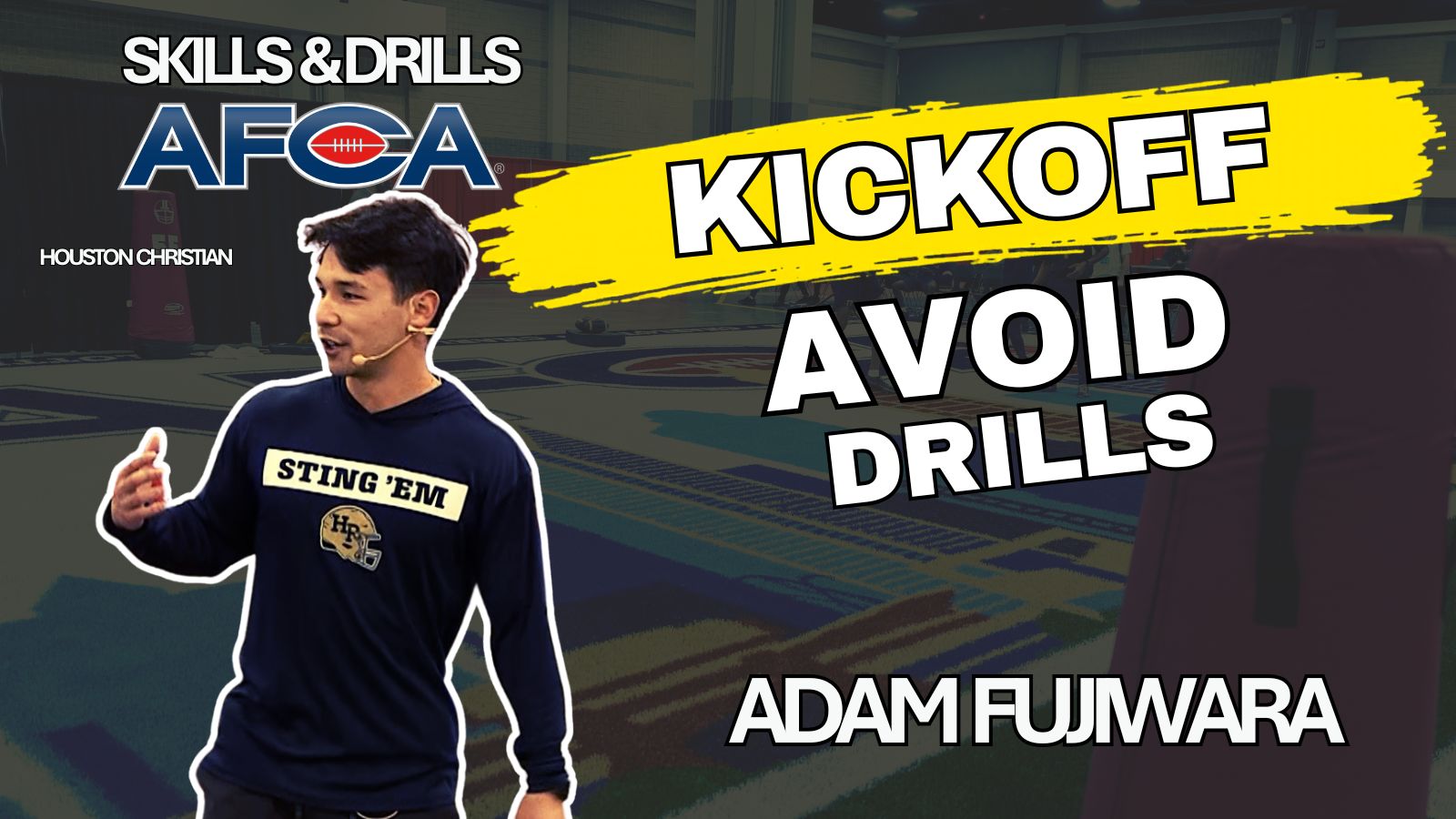
Special teams play requires significant player “buy-in,” as recruits rarely join a program with the dream of playing on the punt or kickoff team. To build a successful unit, Adam Fujiwara, the special teams coordinator at Houston Christian University, emphasizes using clear teaching progressions and translating buzzwords and skills directly from offensive and defensive playbooks. For instance, kickoff avoidance techniques parallel wide receivers attacking coverage or defensive players slipping second-level blocks.
Coach Fujiwara explains that the kickoff coverage team’s responsibilities are broken down into three distinct phases: the avoid zone, the strike zone, and the tackle zone. To help players master the first phase and transition effectively to the last, coaches can utilize the following two foundational drills.
Drill 1: “Shake and Stack” (The Avoid Zone)
The “Shake and Stack” drill focuses on teaching players how to successfully maneuver past blockers while maintaining an optimal path to the ball carrier.
- Every drill must have a clear start and finish. Players begin in a two-point receiver stance and approach a pop-up dummy, a trash can, or a stand-in coach acting as the blocker.
- On a directional command from the coach (e.g., “stick left and avoid right”), the player must stick their foot violently to redirect. It is crucial to avoid any wasted movement or unnecessary hopping going into the break. As they make their move, players must reduce their surface area to slip past the blocker.
- Immediately after avoiding the obstacle, the player must stay as tight as possible and work to “restack,” meaning they must get back onto their vertical running line.
- The drill can be modified based on the blocker’s leverage:
- Loose Defender: If the blocker is loose, the kickoff defender dictates the leverage. The defender should press the blocker’s leverage by stepping on their toes to make them miss, reduce their surface area, and restack.
- Heavy Defender: If the blocker is heavy and oversets, meaning the blocker holds the leverage, the defender must still press the leverage, stick violently to change direction, reduce, and restack on the vertical line.
- Players finish the drill by squaring up on the simulated ball carrier with their near foot and near shoulder forward, and their palms down. Forcing the palms down is a critical coaching point because it automatically enforces proper pad level and deep knee bend.
Drill 2: “Trim the Fat” (Transitioning to the Tackle Zone)
The “Trim the Fat” drill helps players transition smoothly from the speed and avoid zone directly into the tackle zone.
- This drill simulates a scenario where the kickoff return goes away from the defender, requiring them to pursue the play from the backside of the kickoff team.
- Players start in a receiver stance and, on the coach’s command, work around an obstacle, such as a stepover bag. The primary focus is on extreme flexibility; players must dip and bend as much as possible as they round the corner to avoid stiffness.
- Without losing momentum, the player smoothly tags off the simulated ball carrier to complete the pursuit.
Implementing the Drills: These drills are highly versatile and are recommended for use during spring ball, bye weeks, or on day one of fall camp. Running the entire roster through these progressions gives the coaching staff an excellent opportunity to evaluate how well players process and apply coaching instructions early in the season.
2026 Convention Skills & Drills Are Now Live: CLICK HERE
As you prepare for Spring Ball, don’t stop with just one session. All 2026 Skills & Drills presentations from the AFCA Convention are now available in the AFCA Digital Library. AFCA members can log in to watch this tackling system in full, along with hundreds of additional position-specific sessions designed to help you build practice plans, install new drills, and sharpen fundamentals across your program.
If you’re looking to maximize your spring practice efficiency, the AFCA Digital Library is your year-round resource for proven drills, clinic tape, and coaching insight from every level of the game. Log in today and start building your Spring Ball practice script.

For more information about the AFCA, visit www.AFCA.com. For more interesting articles, check out The Insider and subscribe to our weekly email.
If you are interested in more in-depth articles and videos, please become an AFCA member. You can find out more information about membership and specific member benefits on the AFCA Membership Overview page. If you are ready to join, please fill out the AFCA Membership Application.
« « Previous PostNext Post » »
Special teams play requires significant player “buy-in,” as recruits rarely join a program with the dream of playing on the punt or kickoff team. To build a successful unit, Adam Fujiwara, the special teams coordinator at Houston Christian University, emphasizes using clear teaching progressions and translating buzzwords and skills directly from offensive and defensive playbooks. For instance, kickoff avoidance techniques parallel wide receivers attacking coverage or defensive players slipping second-level blocks.
Coach Fujiwara explains that the kickoff coverage team’s responsibilities are broken down into three distinct phases: the avoid zone, the strike zone, and the tackle zone. To help players master the first phase and transition effectively to the last, coaches can utilize the following two foundational drills.
Drill 1: “Shake and Stack” (The Avoid Zone)
The “Shake and Stack” drill focuses on teaching players how to successfully maneuver past blockers while maintaining an optimal path to the ball carrier.
- Every drill must have a clear start and finish. Players begin in a two-point receiver stance and approach a pop-up dummy, a trash can, or a stand-in coach acting as the blocker.
- On a directional command from the coach (e.g., “stick left and avoid right”), the player must stick their foot violently to redirect. It is crucial to avoid any wasted movement or unnecessary hopping going into the break. As they make their move, players must reduce their surface area to slip past the blocker.
- Immediately after avoiding the obstacle, the player must stay as tight as possible and work to “restack,” meaning they must get back onto their vertical running line.
- The drill can be modified based on the blocker’s leverage:
- Loose Defender: If the blocker is loose, the kickoff defender dictates the leverage. The defender should press the blocker’s leverage by stepping on their toes to make them miss, reduce their surface area, and restack.
- Heavy Defender: If the blocker is heavy and oversets, meaning the blocker holds the leverage, the defender must still press the leverage, stick violently to change direction, reduce, and restack on the vertical line.
- Players finish the drill by squaring up on the simulated ball carrier with their near foot and near shoulder forward, and their palms down. Forcing the palms down is a critical coaching point because it automatically enforces proper pad level and deep knee bend.
Drill 2: “Trim the Fat” (Transitioning to the Tackle Zone)
The “Trim the Fat” drill helps players transition smoothly from the speed and avoid zone directly into the tackle zone.
- This drill simulates a scenario where the kickoff return goes away from the defender, requiring them to pursue the play from the backside of the kickoff team.
- Players start in a receiver stance and, on the coach’s command, work around an obstacle, such as a stepover bag. The primary focus is on extreme flexibility; players must dip and bend as much as possible as they round the corner to avoid stiffness.
- Without losing momentum, the player smoothly tags off the simulated ball carrier to complete the pursuit.
Implementing the Drills: These drills are highly versatile and are recommended for use during spring ball, bye weeks, or on day one of fall camp. Running the entire roster through these progressions gives the coaching staff an excellent opportunity to evaluate how well players process and apply coaching instructions early in the season.
2026 Convention Skills & Drills Are Now Live: CLICK HERE
As you prepare for Spring Ball, don’t stop with just one session. All 2026 Skills & Drills presentations from the AFCA Convention are now available in the AFCA Digital Library. AFCA members can log in to watch this tackling system in full, along with hundreds of additional position-specific sessions designed to help you build practice plans, install new drills, and sharpen fundamentals across your program.
If you’re looking to maximize your spring practice efficiency, the AFCA Digital Library is your year-round resource for proven drills, clinic tape, and coaching insight from every level of the game. Log in today and start building your Spring Ball practice script.
For more information about the AFCA, visit www.AFCA.com. For more interesting articles, check out The Insider and subscribe to our weekly email.
If you are interested in more in-depth articles and videos, please become an AFCA member. You can find out more information about membership and specific member benefits on the AFCA Membership Overview page. If you are ready to join, please fill out the AFCA Membership Application.