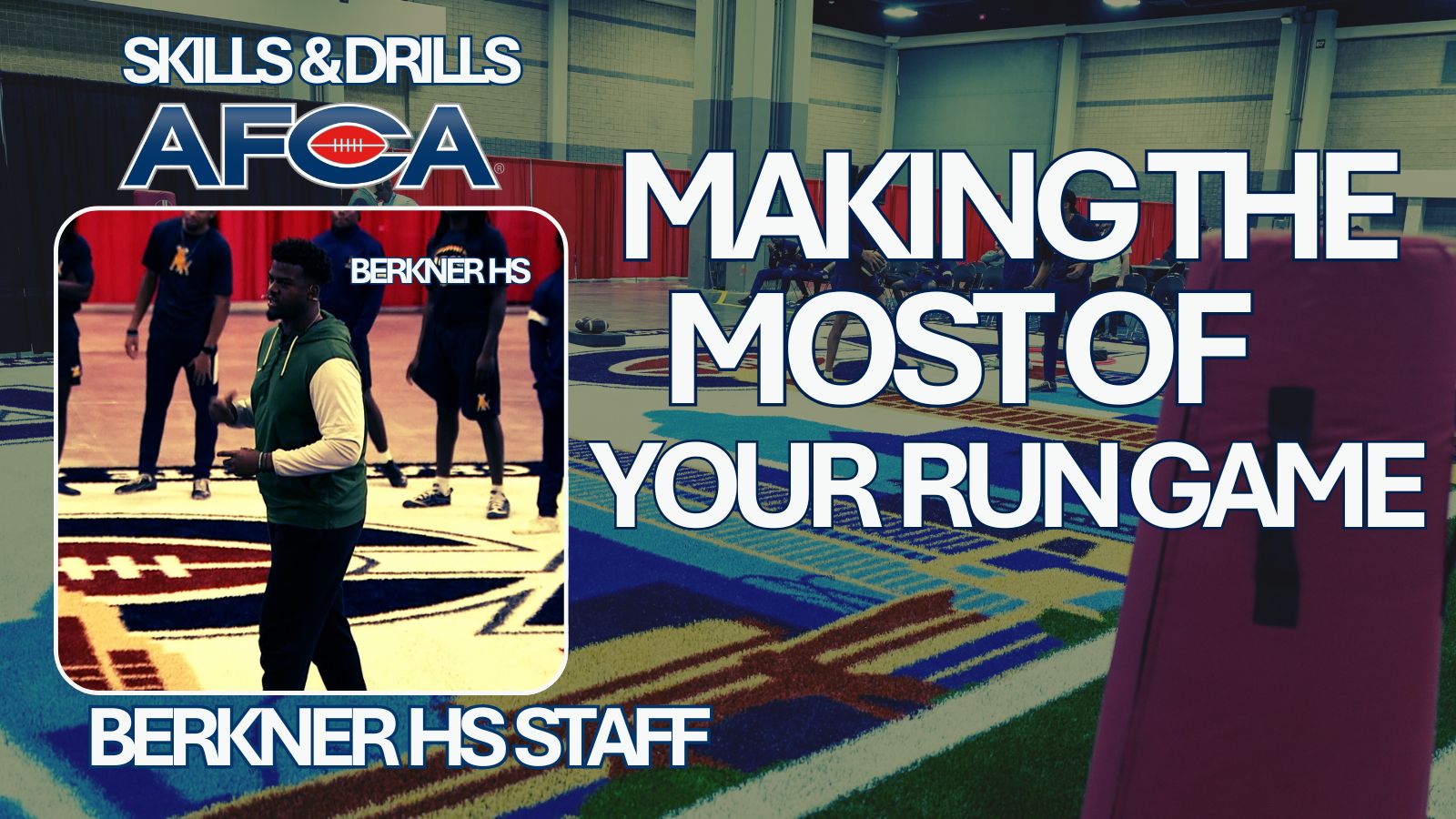
MTM: Making the Most of Your Run Game
March 17, 2026
At the 2026 AFCA Convention in Charlotte, Richardson Berkner (TX) Head Coach Trey Bryant took the Skills & Drills field alongside his Offensive Coordinator/O-Line Coach Brian Parish and Run Game Coordinator/TE Coach Gary Freeman.
The core philosophy of the Richardson Berkner staff is simple: “MTM” – Make The Most.
In this session, the staff broke down exactly how they apply that MTM philosophy to their offensive line and tight end tagging system. By installing very few base plays and relying heavily on key trigger word adjustments, the staff maximizes their blocking schemes without over-complicating assignments for the players.
During the session, the staff detailed their base pull circuit, the mechanics of their “Kick” tag, and how they manipulate defensive fronts using their “Out” and “Stay” tags.
The “Kick” Tag for Counter Schemes
When the offense shifts from power concepts to counter schemes, specifically GH counter or variations utilizing a running back or an off-ball tight end as an extra blocker, Berkner implements their “Kick” tag.
- The Execution: Unlike the base pull drill, where the lineman goes vertical and hugs the cones, the Kick tag requires the puller to attack straight through the cones. The aiming point is hyperspecific: the puller must target the inside of the defender’s shoulder pad, ensuring their helmet and body surface area remain on the inside half of the defender.
- The Goal: The goal of the Kick tag is to forcefully dig out the edge defender to create the interior running lane for the ball carrier and the wrapping second puller. By keeping their helmet inside and delivering a heavy strike to the inside shoulder pad, the puller maintains leverage and prevents the defender from wrong-arming the block or spilling the play to the perimeter.
The “Out” Tag vs. Odd Fronts
Facing a heavy dosage of three-man fronts in their district, Berkner uses an “Out” tag to manipulate the defensive end (specifically 4i techniques) and protect their power concepts.
- The Execution: The offensive tackle starts inside but acts as if he is working to the alleyway linebacker. If the defensive end tracks inside with the tackle, the wrapping guard (running his Kick path) is perfectly positioned to kick the defensive end out.
- The Goal: The purpose of the “Out” tag is to influence the defensive end into widening or declaring his gap. Even if the tackle doesn’t make a devastating block, his movement forces the defender to react, essentially setting up the defensive end to be kicked out by the pulling guard, neutralizing the defense’s ability to spill the play.
The “Heavy” Tag (Tight End Pulls)
To avoid forcing five offensive linemen to learn 15 different plays, Berkner shifts the mental load to their tight ends. The “Heavy” tag turns regular Power into GH Counter simply by asking the H-back to pull.
- The Execution: The tight end/H-back reads the block of the pulling guard ahead of him. To do this effectively, the tight end must push off his outside leg to gain depth on his pull, rather than just turning his shoulders and running flat down the line.
- The Goal: Gaining depth allows the tight end to keep his shoulders square and read the linebacker’s level. If the pulling guard kicks out the edge, the tight end inserts tight off the double team. If the edge defender logs or spills inside, the tight end effortlessly reads the leverage and arcs around the spill to secure the perimeter.
The “Stay” Tag for Play Action
When transitioning to play-action passing off these same looks, Berkner implements the “Stay” tag to keep their pullers from drifting illegally downfield.
- The Execution: The pulling lineman takes the same angle and path as his Kick steps. However, as he approaches the outside hip of the tackle, he must slow his momentum. He reads the edge rusher: if the rusher flies fast up the field, the puller simply engages and walls him off. If the rusher fits inside immediately, the puller converts it into a hard run block.
- The Goal: Is to teach patience. High school linemen naturally want to play fast, but on play-action, playing too fast and pulling too flat allows an edge rusher to easily bend the corner to the quarterback. By throttling down before contact, the puller maintains the ability to redirect and anchor the moving pocket.
Watch the full clip to see how Richardson Berkner is making the most of their offensive line and TE play.
2026 Convention Skills & Drills Are Now Live: CLICK HERE
As you prepare for Spring Ball, don’t stop with just one session. All 2026 Skills & Drills presentations from the AFCA Convention are now available in the AFCA Digital Library. AFCA members can log in to watch this tackling system in full, along with hundreds of additional position-specific sessions designed to help you build practice plans, install new drills, and sharpen fundamentals across your program.
If you’re looking to maximize your spring practice efficiency, the AFCA Digital Library is your year-round resource for proven drills, clinic tape, and coaching insight from every level of the game. Log in today and start building your Spring Ball practice script.

For more information about the AFCA, visit www.AFCA.com. For more interesting articles, check out The Insider and subscribe to our weekly email.
If you are interested in more in-depth articles and videos, please become an AFCA member. You can find out more information about membership and specific member benefits on the AFCA Membership Overview page. If you are ready to join, please fill out the AFCA Membership Application.
« « Previous PostNext Post » »
At the 2026 AFCA Convention in Charlotte, Richardson Berkner (TX) Head Coach Trey Bryant took the Skills & Drills field alongside his Offensive Coordinator/O-Line Coach Brian Parish and Run Game Coordinator/TE Coach Gary Freeman.
The core philosophy of the Richardson Berkner staff is simple: “MTM” – Make The Most.
In this session, the staff broke down exactly how they apply that MTM philosophy to their offensive line and tight end tagging system. By installing very few base plays and relying heavily on key trigger word adjustments, the staff maximizes their blocking schemes without over-complicating assignments for the players.
During the session, the staff detailed their base pull circuit, the mechanics of their “Kick” tag, and how they manipulate defensive fronts using their “Out” and “Stay” tags.
The “Kick” Tag for Counter Schemes
When the offense shifts from power concepts to counter schemes, specifically GH counter or variations utilizing a running back or an off-ball tight end as an extra blocker, Berkner implements their “Kick” tag.
- The Execution: Unlike the base pull drill, where the lineman goes vertical and hugs the cones, the Kick tag requires the puller to attack straight through the cones. The aiming point is hyperspecific: the puller must target the inside of the defender’s shoulder pad, ensuring their helmet and body surface area remain on the inside half of the defender.
- The Goal: The goal of the Kick tag is to forcefully dig out the edge defender to create the interior running lane for the ball carrier and the wrapping second puller. By keeping their helmet inside and delivering a heavy strike to the inside shoulder pad, the puller maintains leverage and prevents the defender from wrong-arming the block or spilling the play to the perimeter.
The “Out” Tag vs. Odd Fronts
Facing a heavy dosage of three-man fronts in their district, Berkner uses an “Out” tag to manipulate the defensive end (specifically 4i techniques) and protect their power concepts.
- The Execution: The offensive tackle starts inside but acts as if he is working to the alleyway linebacker. If the defensive end tracks inside with the tackle, the wrapping guard (running his Kick path) is perfectly positioned to kick the defensive end out.
- The Goal: The purpose of the “Out” tag is to influence the defensive end into widening or declaring his gap. Even if the tackle doesn’t make a devastating block, his movement forces the defender to react, essentially setting up the defensive end to be kicked out by the pulling guard, neutralizing the defense’s ability to spill the play.
The “Heavy” Tag (Tight End Pulls)
To avoid forcing five offensive linemen to learn 15 different plays, Berkner shifts the mental load to their tight ends. The “Heavy” tag turns regular Power into GH Counter simply by asking the H-back to pull.
- The Execution: The tight end/H-back reads the block of the pulling guard ahead of him. To do this effectively, the tight end must push off his outside leg to gain depth on his pull, rather than just turning his shoulders and running flat down the line.
- The Goal: Gaining depth allows the tight end to keep his shoulders square and read the linebacker’s level. If the pulling guard kicks out the edge, the tight end inserts tight off the double team. If the edge defender logs or spills inside, the tight end effortlessly reads the leverage and arcs around the spill to secure the perimeter.
The “Stay” Tag for Play Action
When transitioning to play-action passing off these same looks, Berkner implements the “Stay” tag to keep their pullers from drifting illegally downfield.
- The Execution: The pulling lineman takes the same angle and path as his Kick steps. However, as he approaches the outside hip of the tackle, he must slow his momentum. He reads the edge rusher: if the rusher flies fast up the field, the puller simply engages and walls him off. If the rusher fits inside immediately, the puller converts it into a hard run block.
- The Goal: Is to teach patience. High school linemen naturally want to play fast, but on play-action, playing too fast and pulling too flat allows an edge rusher to easily bend the corner to the quarterback. By throttling down before contact, the puller maintains the ability to redirect and anchor the moving pocket.
Watch the full clip to see how Richardson Berkner is making the most of their offensive line and TE play.
2026 Convention Skills & Drills Are Now Live: CLICK HERE
As you prepare for Spring Ball, don’t stop with just one session. All 2026 Skills & Drills presentations from the AFCA Convention are now available in the AFCA Digital Library. AFCA members can log in to watch this tackling system in full, along with hundreds of additional position-specific sessions designed to help you build practice plans, install new drills, and sharpen fundamentals across your program.
If you’re looking to maximize your spring practice efficiency, the AFCA Digital Library is your year-round resource for proven drills, clinic tape, and coaching insight from every level of the game. Log in today and start building your Spring Ball practice script.
For more information about the AFCA, visit www.AFCA.com. For more interesting articles, check out The Insider and subscribe to our weekly email.
If you are interested in more in-depth articles and videos, please become an AFCA member. You can find out more information about membership and specific member benefits on the AFCA Membership Overview page. If you are ready to join, please fill out the AFCA Membership Application.