Using Pullers to Control Space and Create Running Lanes
June 2, 2026
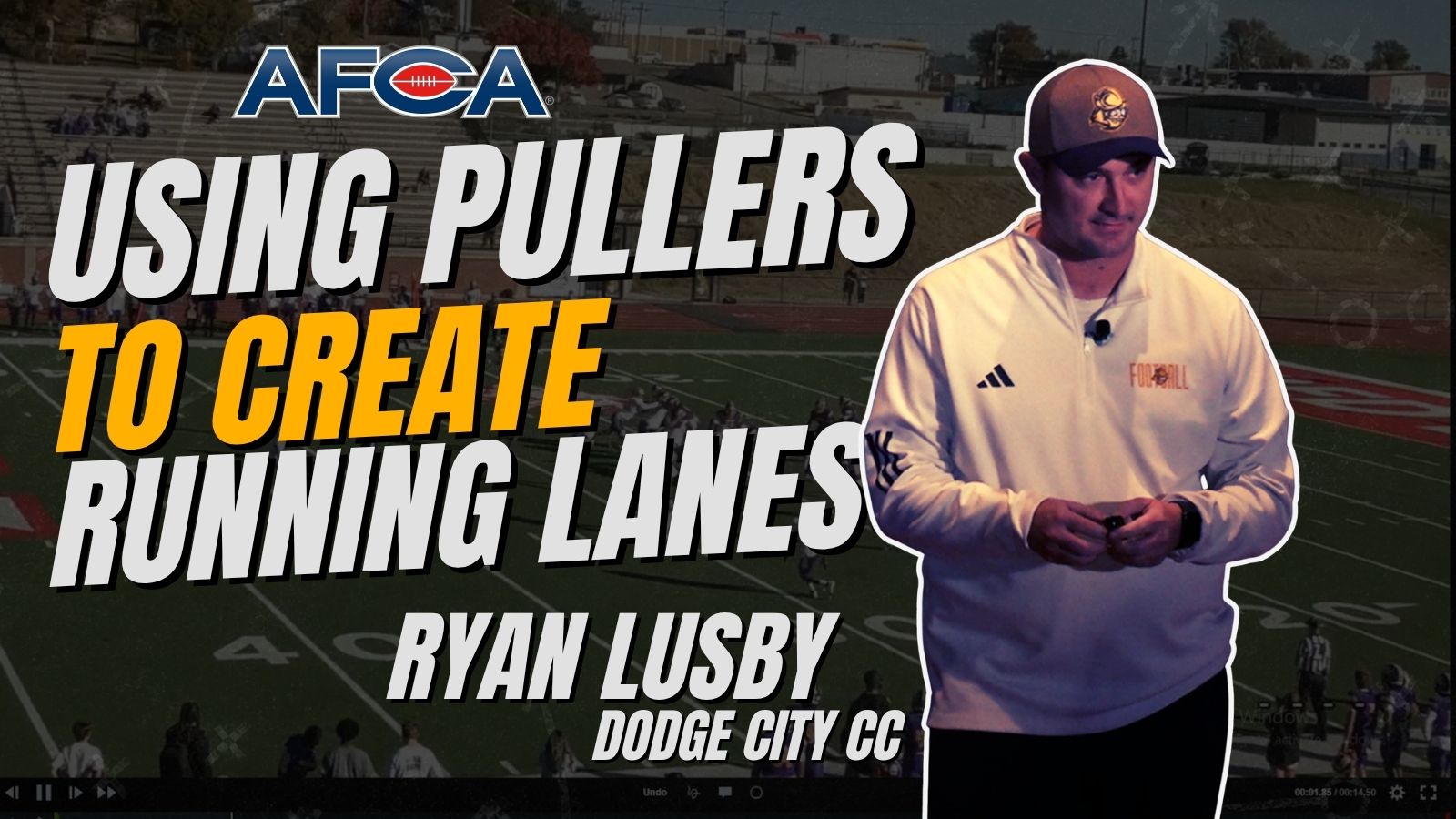
At the 2026 AFCA Convention, Dodge City Community College Head Coach Ryan Lusby presented on using pullers to control space and create running lanes. His core message was simple: when defensive lines are more athletic than offensive lines, offense cannot afford to block in open space. His answer is to switch pullers, eliminate space, and make the defense chase the wrong man.
Here is the breakdown of his teaching progression and key points from the session.
GY Counter: The Base and the Switch Call
Lusby started with the classic GY Counter and broke down their calls and variations versus different looks. The base look comes from an under front: backside guard pulls, center blocks back to the backside linebacker, and H-back or tight end pulls to the front-side ID.
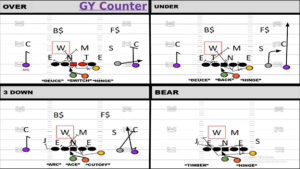
From an Over front with a 3 technique on the tight end side, Lusby teaches a switch call. The center pulls while the backside guard stays on the 3 technique. This removes the space the center usually has to cover and gets the center to the defensive end faster.
Versus a 3 down base look, the front-side tackle arcs and the puller kicks the front-side 4 tech. 4 techniques are rarely kicked or arced. When they are not blocked directly, they often jet upfield and take themselves out of the play.
Versus a true Bear front (5-1 or 5-2 box), the play returns to the classic formula: pull the guard, pull the tight end, hinge block, and get both edges covered. The backside tackle must be strong here because the 3 technique is still a threat.
Key Coaching Points:
- Switch calls eliminate space and reduce the athletic gap between linemen.
- Arcing the front-side tackle on 3 down looks forces the 4 technique to chase.
- Always rep all fronts; do not treat them as separate plays.
G Lead
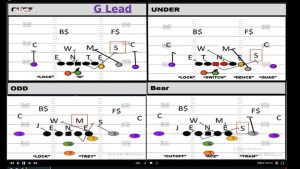
G Lead is another gap-scheme concept where the puller in Lusby’s offense can change based on the front:
– Over front: Pull the Guard to the +1 guy outside of the box; Pin the End; Crack the Mike.
– Under front: Switch call. Pull the Center to the +1 guy outside of the box; PS Guard and PS Tackle work through the nose to the backside backer. TE & TE/WR work through End to the Mike.
– Odd front: Put the WR on the +1 guy. Fold the RG around and pull to the Mike.
– Bear front: Strike call. (alerts that the Sam is on the line of scrimmage) The TE and Tackle will work through the end to the Mike; The PS Guard and Center will work through the Nose to the BS Backer. Turns the play into power by rules.
Key Coaching Points:
Other Notes From Coach Lusby: Motion is critical. Lusby mentions he likes to motion a receiver or back across the formation to help crack the safety or get a plus-one blocker in space. The goal is always the same: get the defense blocked, get the puller moving downhill, and create a numbers advantage at the point of attack. Coach Lusby also talks about how he likes creating counters without pulling offensive linemen. He believes some of the best-looking counters in the system come from 12 or 13 personnel, where the pullers are tight ends, not offensive linemen. In a bunch formation with two receivers outside the bunch, those receivers work down to the first defender in the box, and the inside tight end pulls around for priority outside. The offensive line blocks like inside zone or no-pull power, and the tight end becomes the edge force. This is useful if guards and centers are not great pullers. Tight ends often have better angles, better vision, and less contact to carry through the hole.
One of Lusby’s favorite constraints is pairing a jet sweep action with a counter back in the opposite direction. The jet motion holds the overhang defender and pulls eyes away from the backside puller. If the 4 technique steps aggressively because he is not used to being read, the quarterback can pull the ball and let the backside tackle work back inside to the backer while the receiver blocks the overhang player.
This read works both ways: hand the jet sweep away from the puller, or let the quarterback pull and run counter back. The defense is forced to honor both, and the offense retains a numbers advantage on the backside.
Bottom Line:
Gap scheme with flexible pullers is not a mysterious offense. It is a rules-based approach that asks your athletes to process looks and react, rather than memorize four different blocking schemes. By switching who pulls based on the front, you eliminate space, reduce the load on your interior linemen, and put your best athletes in position to make plays out in open space.
When the defense is bigger, faster, or more athletic than your offensive line, you do not need bigger offensive linemen. You need smarter calls, clearer rules, and more repetitions.
The 2027 AFCA Convention heads to Indianapolis, Indiana, February 14-16, bringing together thousands of football coaches from every level of the game for three days of professional development, networking, and football education.
Registration and membership renewal for the 2027 AFCA Convention will open in July. Become an AFCA member to gain access to Convention, the AFCA Digital Library, career resources, coaching education, and more.
Make plans now to join us in Indianapolis and experience the world’s largest football coaching convention.
2026 Convention Videos Are Now Live: CLICK HERE

For more information about the AFCA, visit www.AFCA.com. For more interesting articles, check out The Insider and subscribe to our weekly email.
If you are interested in more in-depth articles and videos, please become an AFCA member. You can find out more information about membership and specific member benefits on the AFCA Membership Overview page. If you are ready to join, please fill out the AFCA Membership Application.
« « Previous PostNext Post » »
At the 2026 AFCA Convention, Dodge City Community College Head Coach Ryan Lusby presented on using pullers to control space and create running lanes. His core message was simple: when defensive lines are more athletic than offensive lines, offense cannot afford to block in open space. His answer is to switch pullers, eliminate space, and make the defense chase the wrong man.
Here is the breakdown of his teaching progression and key points from the session.
GY Counter: The Base and the Switch Call
Lusby started with the classic GY Counter and broke down their calls and variations versus different looks. The base look comes from an under front: backside guard pulls, center blocks back to the backside linebacker, and H-back or tight end pulls to the front-side ID.
From an Over front with a 3 technique on the tight end side, Lusby teaches a switch call. The center pulls while the backside guard stays on the 3 technique. This removes the space the center usually has to cover and gets the center to the defensive end faster.
Versus a 3 down base look, the front-side tackle arcs and the puller kicks the front-side 4 tech. 4 techniques are rarely kicked or arced. When they are not blocked directly, they often jet upfield and take themselves out of the play.
Versus a true Bear front (5-1 or 5-2 box), the play returns to the classic formula: pull the guard, pull the tight end, hinge block, and get both edges covered. The backside tackle must be strong here because the 3 technique is still a threat.
Key Coaching Points:
- Switch calls eliminate space and reduce the athletic gap between linemen.
- Arcing the front-side tackle on 3 down looks forces the 4 technique to chase.
- Always rep all fronts; do not treat them as separate plays.
G Lead
G Lead is another gap-scheme concept where the puller in Lusby’s offense can change based on the front:
– Over front: Pull the Guard to the +1 guy outside of the box; Pin the End; Crack the Mike.
– Under front: Switch call. Pull the Center to the +1 guy outside of the box; PS Guard and PS Tackle work through the nose to the backside backer. TE & TE/WR work through End to the Mike.
– Odd front: Put the WR on the +1 guy. Fold the RG around and pull to the Mike.
– Bear front: Strike call. (alerts that the Sam is on the line of scrimmage) The TE and Tackle will work through the end to the Mike; The PS Guard and Center will work through the Nose to the BS Backer. Turns the play into power by rules.
Key Coaching Points:
Other Notes From Coach Lusby: Motion is critical. Lusby mentions he likes to motion a receiver or back across the formation to help crack the safety or get a plus-one blocker in space. The goal is always the same: get the defense blocked, get the puller moving downhill, and create a numbers advantage at the point of attack. Coach Lusby also talks about how he likes creating counters without pulling offensive linemen. He believes some of the best-looking counters in the system come from 12 or 13 personnel, where the pullers are tight ends, not offensive linemen. In a bunch formation with two receivers outside the bunch, those receivers work down to the first defender in the box, and the inside tight end pulls around for priority outside. The offensive line blocks like inside zone or no-pull power, and the tight end becomes the edge force. This is useful if guards and centers are not great pullers. Tight ends often have better angles, better vision, and less contact to carry through the hole.
One of Lusby’s favorite constraints is pairing a jet sweep action with a counter back in the opposite direction. The jet motion holds the overhang defender and pulls eyes away from the backside puller. If the 4 technique steps aggressively because he is not used to being read, the quarterback can pull the ball and let the backside tackle work back inside to the backer while the receiver blocks the overhang player.
This read works both ways: hand the jet sweep away from the puller, or let the quarterback pull and run counter back. The defense is forced to honor both, and the offense retains a numbers advantage on the backside.
Bottom Line:
Gap scheme with flexible pullers is not a mysterious offense. It is a rules-based approach that asks your athletes to process looks and react, rather than memorize four different blocking schemes. By switching who pulls based on the front, you eliminate space, reduce the load on your interior linemen, and put your best athletes in position to make plays out in open space.
When the defense is bigger, faster, or more athletic than your offensive line, you do not need bigger offensive linemen. You need smarter calls, clearer rules, and more repetitions.
The 2027 AFCA Convention heads to Indianapolis, Indiana, February 14-16, bringing together thousands of football coaches from every level of the game for three days of professional development, networking, and football education.
Registration and membership renewal for the 2027 AFCA Convention will open in July. Become an AFCA member to gain access to Convention, the AFCA Digital Library, career resources, coaching education, and more.
Make plans now to join us in Indianapolis and experience the world’s largest football coaching convention.
For more information about the AFCA, visit www.AFCA.com. For more interesting articles, check out The Insider and subscribe to our weekly email.
If you are interested in more in-depth articles and videos, please become an AFCA member. You can find out more information about membership and specific member benefits on the AFCA Membership Overview page. If you are ready to join, please fill out the AFCA Membership Application.