Developing Quarterback Fundamentals Through EDDs
May 19, 2026
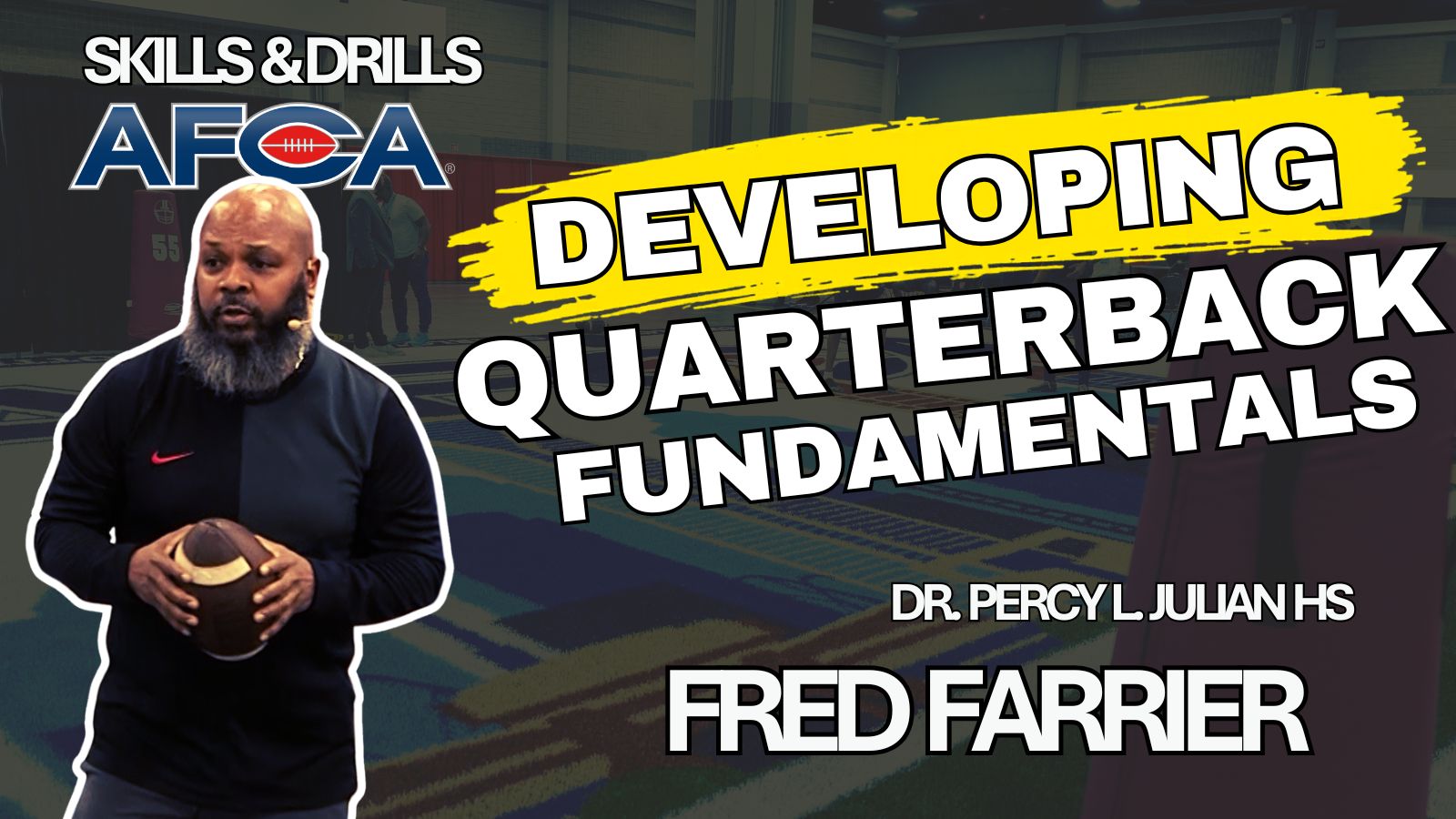
Fred Farrier, head coach at Dr. Percy L. Julian High School, believes that the foundation of quarterback play is built during individual periods, not in team or subgroup work. During the 2026 AFCA Convention, Coach Farrier shares his approach that emphasizes self-contained drills that can be executed with just 2–6 quarterbacks, allowing players to master mechanics, footwork, and pre-snap decision-making before they ever work with receivers or running backs.
Coach Farrier firmly believes that the individual period is where you make your money as a position coach. During indy, the goal is simple: make every throw perfect and put the ball on the receiver’s numbers, both shoulders, or facemask to simplify the catch.
Pre-Practice Warm-Up
Farrier begins his quarterback work 10–15 minutes before practice with a structured throwing progression:
-Start 10 yards apart with a basic step-throw-finish (no footwork emphasis).
-Progress distances gradually: 10 → 15 → 20 → 25 → 30 yards.
-At 15+ yards, incorporate the quick three-step footwork (1-2-3, step on 4).
-Level 1 throws (10–25 yards) should be driven with no air under the ball.
-Level 2 throws (25–30 yards) should get over linebackers but drop in front of safeties.
-He prefers an even number of quarterbacks so throws are synchronized (one ball leaving as another arrives).
One-Step Quick Game Footwork
For quick game throws, Farrier breaks down footwork by direction:
-Right side: Closed hips and shoulders with a push-step-drive.
-Left side: Open hips and shoulders (or a crossover step for momentum).
-The drill sequence is “Set hit” → 1-step throw → “Reload,” repeated three times in each direction.
Three-Step and Five-Step Drop Work
Farrier uses three-step drops from shotgun to simulate five-step timing. Daily progressions include:
-3 steps, no hitch, throw on the 4th step
-3 steps + 1 hitch
-3 steps + 2 hitches (then find the running back or throw away)
He stresses pre-snap determination to cut the field in half based on middle-field open versus middle-field closed coverage.
Simulation Drills
One of the strengths of Farrier’s system is that it requires no additional position groups. Using bags, lines, or a second quarterback as a target, he simulates:
Hitch routes (5–6 yards)
Curl routes (≈12 yards)
Quick outs
Seam/vertical routes (18–24 yards)
The emphasis is on timing and accuracy. The ball must arrive on time and on target even without a moving receiver.
Pre-Snap Process
Farrier drills a clear pre-snap checklist daily:
-Identify middle field open (two safeties) vs. middle field closed.
-Read corner alignment and movement (Cover 2/4 vs. quarters or man).
-Check box count and safety movement/roll indicators.
-Pre-determine the starting side of the route concept.
-Make a decision within approximately four seconds and get the ball out quickly.
-His repeated message to quarterbacks is clear: “Take the check down. Take the check down. Take the check down.”
Farrier’s system allows a quarterback coach to fully prepare his players during individual periods. By the time the group moves to subgroup or team work, the quarterbacks have already been through their mechanics, footwork, and reads.
2026 Convention Skills & Drills Are Now Live: CLICK HERE
As you prepare for Spring Ball, don’t stop with just one session. All 2026 Skills & Drills presentations from the AFCA Convention are now available in the AFCA Digital Library. AFCA members can log in to watch this tackling system in full, along with hundreds of additional position-specific sessions designed to help you build practice plans, install new drills, and sharpen fundamentals across your program.
If you’re looking to maximize your spring practice efficiency, the AFCA Digital Library is your year-round resource for proven drills, clinic tape, and coaching insight from every level of the game. Log in today and start building your Spring Ball practice script.

For more information about the AFCA, visit www.AFCA.com. For more interesting articles, check out The Insider and subscribe to our weekly email.
If you are interested in more in-depth articles and videos, please become an AFCA member. You can find out more information about membership and specific member benefits on the AFCA Membership Overview page. If you are ready to join, please fill out the AFCA Membership Application.
« « Previous PostNext Post » »
Fred Farrier, head coach at Dr. Percy L. Julian High School, believes that the foundation of quarterback play is built during individual periods, not in team or subgroup work. During the 2026 AFCA Convention, Coach Farrier shares his approach that emphasizes self-contained drills that can be executed with just 2–6 quarterbacks, allowing players to master mechanics, footwork, and pre-snap decision-making before they ever work with receivers or running backs.
Coach Farrier firmly believes that the individual period is where you make your money as a position coach. During indy, the goal is simple: make every throw perfect and put the ball on the receiver’s numbers, both shoulders, or facemask to simplify the catch.
Pre-Practice Warm-Up
Farrier begins his quarterback work 10–15 minutes before practice with a structured throwing progression:
-Start 10 yards apart with a basic step-throw-finish (no footwork emphasis).
-Progress distances gradually: 10 → 15 → 20 → 25 → 30 yards.
-At 15+ yards, incorporate the quick three-step footwork (1-2-3, step on 4).
-Level 1 throws (10–25 yards) should be driven with no air under the ball.
-Level 2 throws (25–30 yards) should get over linebackers but drop in front of safeties.
-He prefers an even number of quarterbacks so throws are synchronized (one ball leaving as another arrives).
One-Step Quick Game Footwork
For quick game throws, Farrier breaks down footwork by direction:
-Right side: Closed hips and shoulders with a push-step-drive.
-Left side: Open hips and shoulders (or a crossover step for momentum).
-The drill sequence is “Set hit” → 1-step throw → “Reload,” repeated three times in each direction.
Three-Step and Five-Step Drop Work
Farrier uses three-step drops from shotgun to simulate five-step timing. Daily progressions include:
-3 steps, no hitch, throw on the 4th step
-3 steps + 1 hitch
-3 steps + 2 hitches (then find the running back or throw away)
He stresses pre-snap determination to cut the field in half based on middle-field open versus middle-field closed coverage.
Simulation Drills
One of the strengths of Farrier’s system is that it requires no additional position groups. Using bags, lines, or a second quarterback as a target, he simulates:
Hitch routes (5–6 yards)
Curl routes (≈12 yards)
Quick outs
Seam/vertical routes (18–24 yards)
The emphasis is on timing and accuracy. The ball must arrive on time and on target even without a moving receiver.
Pre-Snap Process
Farrier drills a clear pre-snap checklist daily:
-Identify middle field open (two safeties) vs. middle field closed.
-Read corner alignment and movement (Cover 2/4 vs. quarters or man).
-Check box count and safety movement/roll indicators.
-Pre-determine the starting side of the route concept.
-Make a decision within approximately four seconds and get the ball out quickly.
-His repeated message to quarterbacks is clear: “Take the check down. Take the check down. Take the check down.”
Farrier’s system allows a quarterback coach to fully prepare his players during individual periods. By the time the group moves to subgroup or team work, the quarterbacks have already been through their mechanics, footwork, and reads.
2026 Convention Skills & Drills Are Now Live: CLICK HERE
As you prepare for Spring Ball, don’t stop with just one session. All 2026 Skills & Drills presentations from the AFCA Convention are now available in the AFCA Digital Library. AFCA members can log in to watch this tackling system in full, along with hundreds of additional position-specific sessions designed to help you build practice plans, install new drills, and sharpen fundamentals across your program.
If you’re looking to maximize your spring practice efficiency, the AFCA Digital Library is your year-round resource for proven drills, clinic tape, and coaching insight from every level of the game. Log in today and start building your Spring Ball practice script.
For more information about the AFCA, visit www.AFCA.com. For more interesting articles, check out The Insider and subscribe to our weekly email.
If you are interested in more in-depth articles and videos, please become an AFCA member. You can find out more information about membership and specific member benefits on the AFCA Membership Overview page. If you are ready to join, please fill out the AFCA Membership Application.